There are moments in the history of human thought when a civilisation turns its gaze away from the practical concerns of survival and asks questions that seem almost impossibly large.
Who are we?
What is this universe?
Why does anything exist at all?
Ancient India produced many such moments. The forests that echoed with Vedic chants were not merely places of ritual; they were laboratories of consciousness. Long before observatories, particle accelerators, or mathematical cosmology, generations of seekers turned their attention inward, convinced that the deepest mysteries of the cosmos might somehow be reflected within the depths of the human mind.
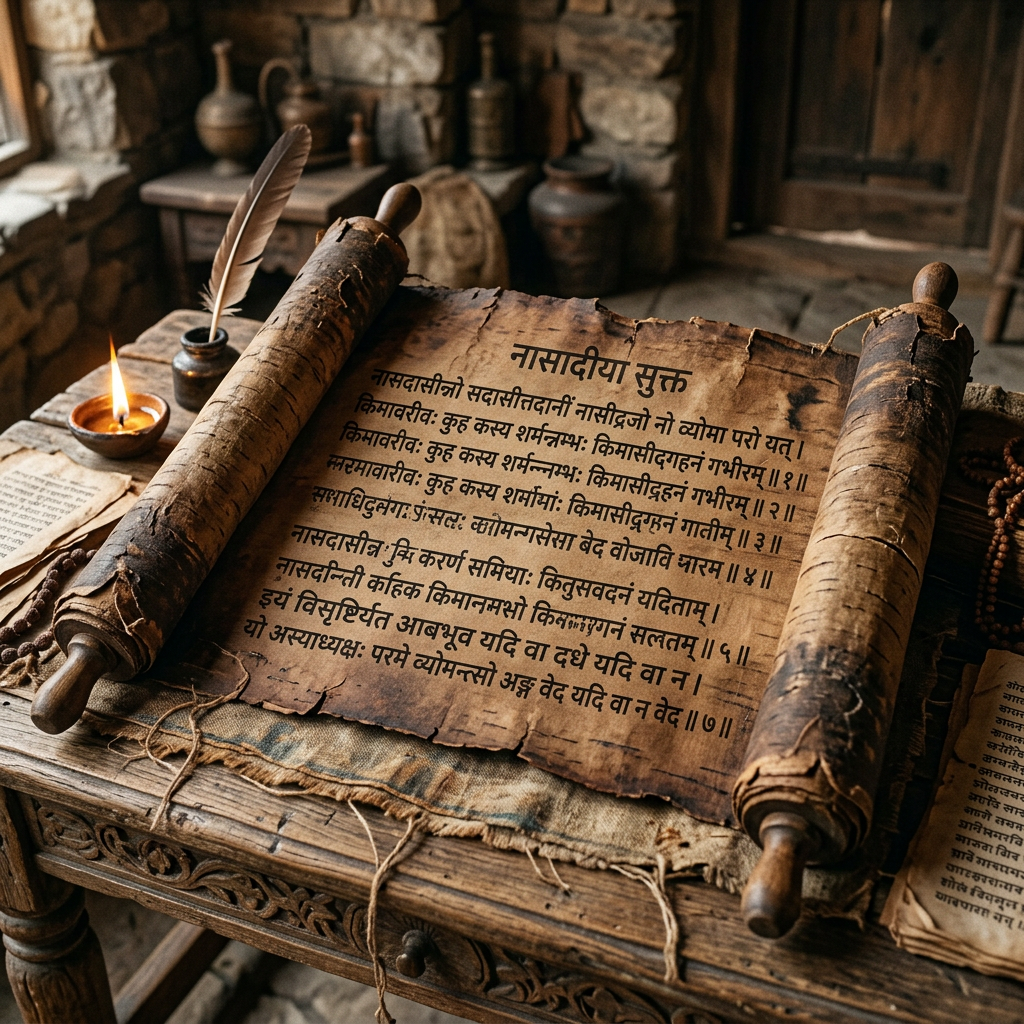
Among the most extraordinary products of this intellectual adventure is the Nasadiya Sukta, the Hymn of Creation, found in the Tenth Mandala of the Rigveda.
Composed more than three thousand years ago, it stands apart from almost every other creation account in the ancient world.
It offers no divine battle.
No cosmic craftsman.
No triumphant declaration of certainty.
Instead, it confronts the greatest of all questions with breathtaking honesty:
What was there before anything was there?
And can anyone truly know?
The genius of the hymn lies not in the answers it gives, but in the questions, it refuses to silence.
Its opening verses remain among the most philosophically daring lines ever composed:
“Then there was neither non-being nor being.”
With these words the poet removes every category upon which ordinary thought depends. There is no earth, no sky, no death, no immortality, no distinction between day and night. The universe is imagined not as empty space but as a reality prior to all differentiation, beyond the conceptual architecture through which human beings normally understand existence.
This is not mythology in the conventional sense. It is metaphysics in poetic form. The rishi is attempting to think the unthinkable. The question itself is astonishing. How does one speak of a state before existence? How does one describe a reality before time, before causation, before language itself? The answer of the Nasadiya Sukta is that perhaps one cannot. And yet the attempt must be made.
The Intellectual Revolution of the Vedic Seers;
Modern readers sometimes underestimate the philosophical sophistication of the Vedic world because it is separated from us by immense stretches of time.
Yet the authors of these hymns were not merely priests performing rituals. They were among humanity’s earliest speculative thinkers. The Sanskrit word rishi is often translated as “sage,” but it literally suggests one who sees. The Vedic seers sought knowledge not primarily through manipulation of the external world but through disciplined observation of consciousness itself. In later centuries this inward journey would culminate in the Upanishads, where inquiry into the self became inseparable from inquiry into the cosmos.
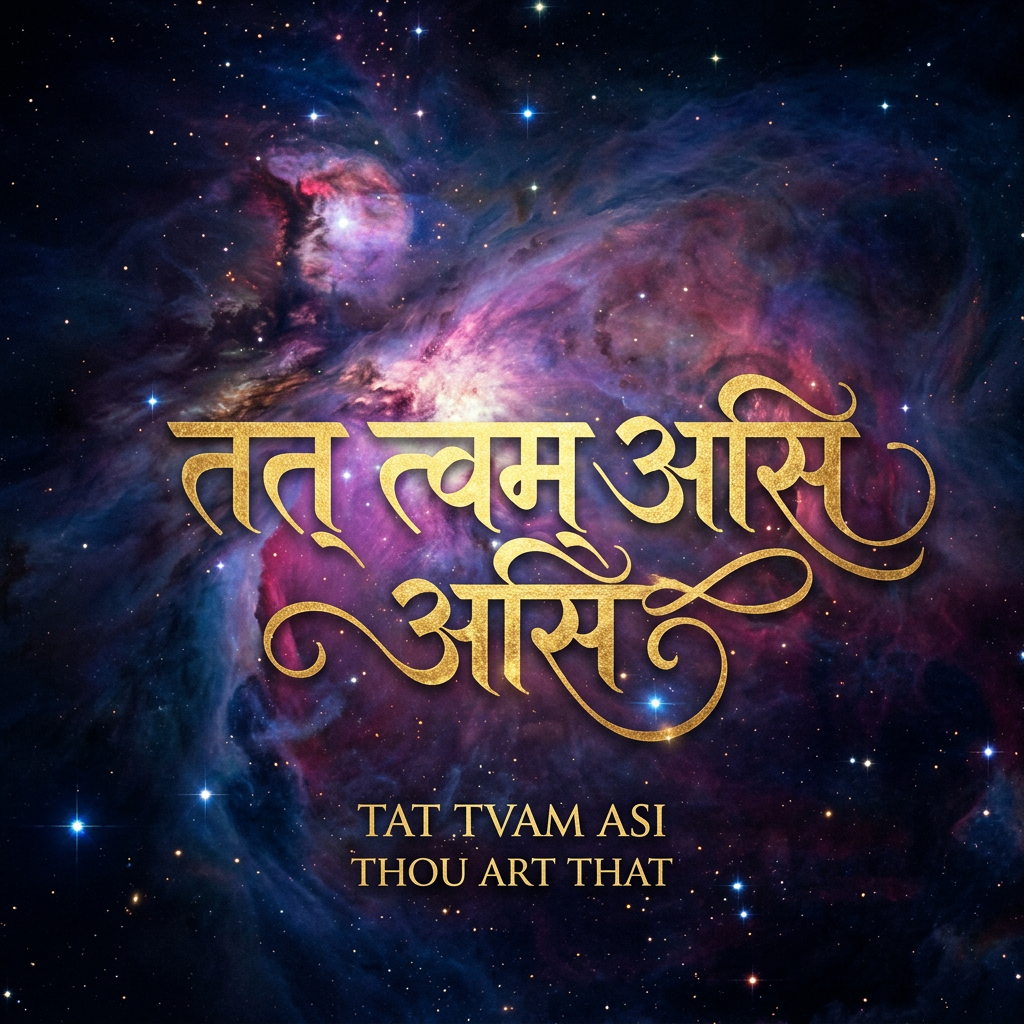
The famous declaration Tat Tvam Asi—”Thou Art That”—would emerge from this tradition. The universe was not viewed as something entirely separate from the observer. The mystery outside and the mystery within were reflections of one another. Seen in this context, the Nasadiya Sukta becomes more than a creation hymn. It becomes an exploration of the limits of thought itself.
From the One to the Many;
The hymn introduces a mysterious principle known simply as Tad Ekam—”That One.” The phrase is intentionally elusive. It is not presented as a personal god issuing commands. Nor is it described as a material substance. It is a symbol pointing toward an underlying unity from which all distinctions eventually emerge.
This intuition would later flower into the non-dual philosophy of Adi Shankara. For Shankara, the ultimate reality was Brahman: infinite, indivisible, beyond all attributes and conceptual categories. The multiplicity we experience is real at the level of everyday life, yet beneath that diversity lies a deeper unity that cannot be divided.
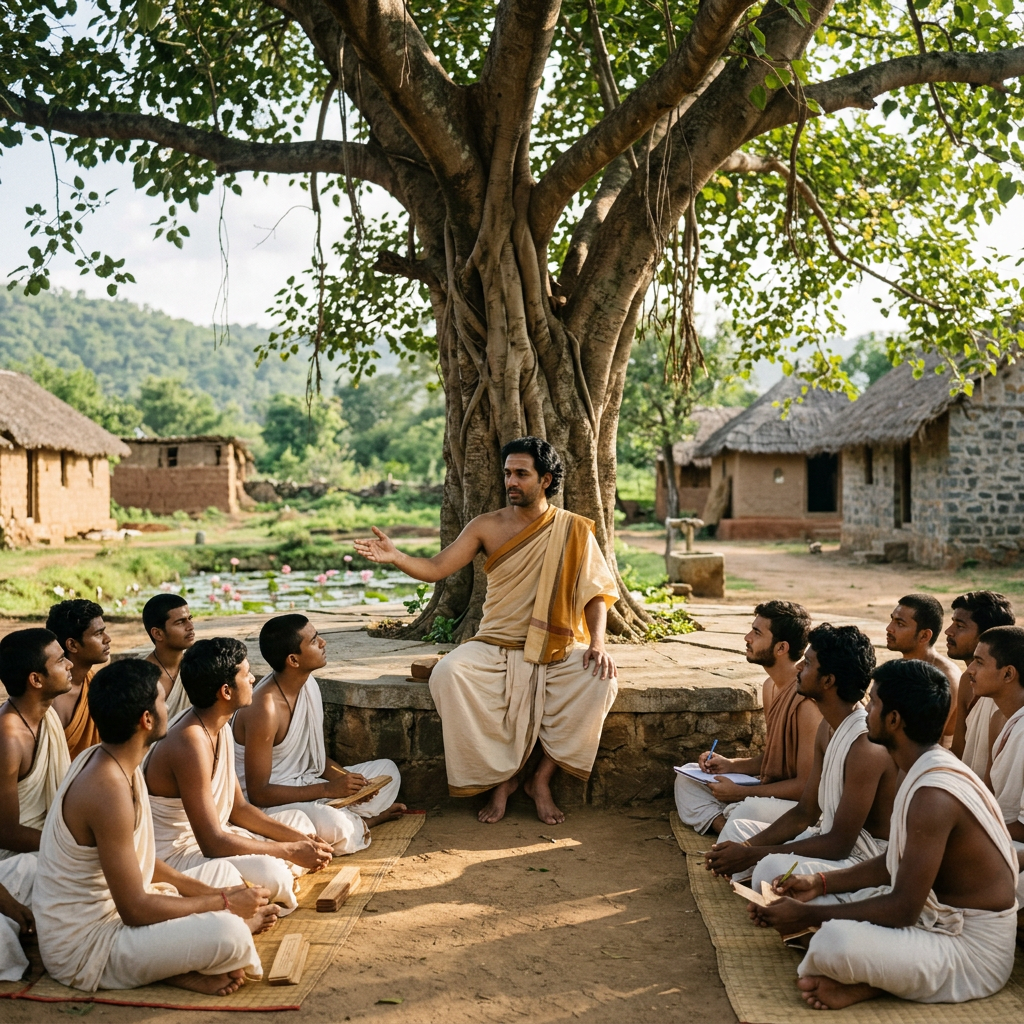
The resonance with the Nasadiya Sukta is unmistakable. Both suggest that reality, at its deepest level, transcends the opposites through which the human mind ordinarily thinks.
Existence and non-existence.
Subject and object.
One and many.
Time and eternity.
The closer one approaches the source, the less useful these distinctions become.
The Modern Search for Unity;
Modern physics, though operating through entirely different methods, is engaged in a search that bears a structural resemblance to this ancient intuition. The great ambition of theoretical physics has long been the discovery of a unified description of nature—a framework showing how the apparent diversity of forces and particles emerges from a deeper underlying reality.
The physicist’s quest for a unified field is not the rishi’s search for Brahman. One belongs to science; the other to metaphysics. Yet both are animated by a similar question: How does the many arise from the one?
At the deepest levels of inquiry, both traditions move toward greater simplicity rather than greater complexity. The multiplicity of the world begins to look like an unfolding of something more fundamental. A question arises as to if we are looking at the same principle using different yardsticks?
Heisenberg and the Limits of Knowing;
The twentieth century introduced another idea that would have surprised earlier generations of scientists. For centuries it was assumed that reality could, in principle, be known completely. If one possessed sufficient information, the universe would become fully predictable. Quantum mechanics shattered that confidence. Werner Heisenberg’s uncertainty principle demonstrated that certain properties cannot simultaneously be known with unlimited precision.
This is not a failure of technology. It is a feature of reality itself. Nature places limits upon what can be known.
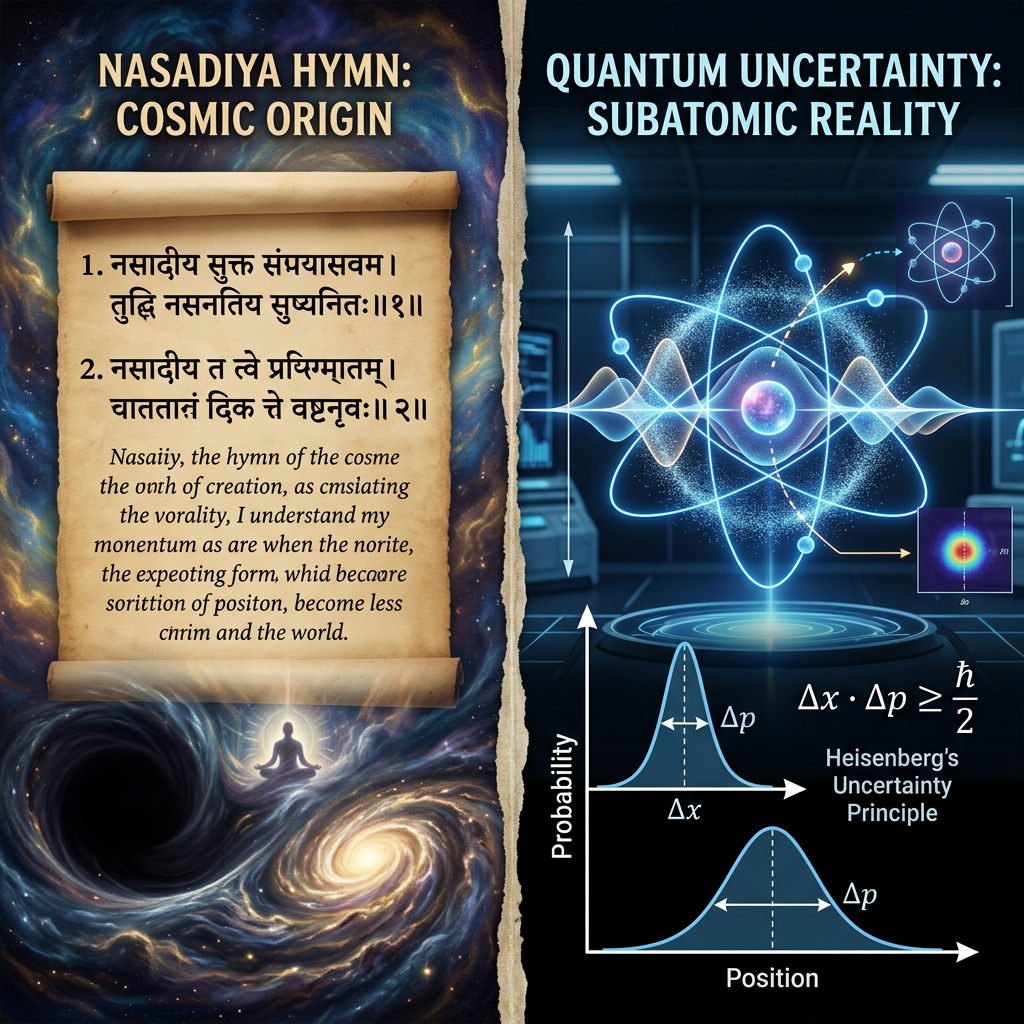
The Nasadiya Sukta arrives at a remarkably similar attitude, though by a very different route. Its final verses do not proclaim certainty. They culminate in wonder:
“Who truly knows?
Who can here declare it?
Whence was it born?
Whence came this creation?”
The hymn then takes a step that remains startling even today. Perhaps, it suggests, even the highest principle may not know. Whether interpreted literally, poetically, or ironically, the effect is profound. The text refuses dogmatism. The mystery remains intact.
Mystery as Wisdom;
Perhaps this is why the Nasadiya Sukta still speaks so powerfully across millennia. Modern civilisation possesses tools the Vedic seers could scarcely have imagined. We can map galaxies billions of light-years away. We can probe subatomic particles. We can detect echoes of the early universe. And yet the ultimate questions remain.
Why is there something rather than nothing?
What preceded the beginning?
Why do the laws of nature exist at all?
The farther knowledge advances, the more clearly we perceive the horizon beyond it. The great lesson of the Nasadiya Sukta is not that ancient India anticipated modern science. It is something far more valuable. It teaches intellectual humility. The hymn invites us to stand before the mystery of existence without rushing to fill it with certainty. In an age saturated with opinions, ideologies, and competing claims to absolute truth, that humility may be one of the most important inheritances the ancient world has left us.
A Vedic poet gazing into the darkness before creation, Adi Shankara contemplating the nature of Brahman, and a modern physicist wrestling with the equations of the quantum world are not saying the same thing. Yet they share a common disposition. Each recognises that reality is deeper than our descriptions of it. Each encounters a boundary beyond which language begins to fail. And each, standing at that frontier, chooses wonder over certainty. Perhaps that is the true beginning of wisdom.
Shankar Kashyap
Sonnet: Before the Beginning
When neither being was nor non-being known,
No sky arched high, no earth beneath was laid;
The silent One abided all alone,
Unseen, unnamed, in darkness unbetrayed.
No moon marked time, no sun proclaimed the day,
No death had come, no life had yet begun;
From depths beyond all thought there stirred a way,
And many worlds emerged from only One.
The sages searched within their hearts to find
The source from which the streams of being flow;
Yet still the primal secret veils the mind,
Beyond the furthest reach of what we know.
We stand where ancient wonder still has trod—
Between the question and the face of God.
Shankar Kashyap
 Shankar Kashyap
Leave a comment