Free Speech, Misinformation, and Democracy in a Young Nation
Between Sovereignty and Surveillance in a Young Democracy
Every age invents its anxieties. Ours has chosen the internet as both cathedral and battlefield. In this invisible republic, speech outpaces thought, virality outruns verification, and consequence struggles to keep up.
Into this charged landscape steps India—frequently cast as both warning and case study. In the global press, particularly in outlets like The New York Times, (https://www.nytimes.com/2026/05/01/opinion/india-modi-internet-censorship.html?smid=url-share) India’s digital policies are increasingly framed as Exhibit A in the argument that the world’s largest democracy is drifting toward illiberalism.
A recent guest essay by Arman Khan advances precisely this claim. It portrays a government tightening its grip over the digital commons, stifling satire, and operating within a “Hindu-chauvinist” framework that leaves minorities—especially Muslims—fearful and self-censoring. It is a compelling narrative. But compelling narratives often compress complexity into clarity—and in doing so, risk distorting the truth.
The Scale of the Challenge
The Shape of Power in a Noisy Republic;
There is, undeniably, a shift underway. The Indian state has grown more assertive in its regulation of digital space—shortening response times, expanding oversight to influencers and “news and current affairs” content, and nudging platforms toward stricter compliance. Recent amendments to the IT Rules introduce tighter takedown windows (including three-hour requirements for certain content) and greater accountability for synthetic media and misinformation.
These are not trivial developments. Speed can suffocate deliberation. Authority, when unchecked, can lean toward excess. And yet, to view these moves in isolation is to mistake a fragment for the whole.
India is not a quiet polity being gradually silenced. It is a vast, argumentative civilisation of voices—often discordant, frequently combustible—now amplified by the architecture of the internet. Rumour here does not merely misinform; it can inflame. Words, in certain contexts, have crossed the thin line into violence. A state confronting such realities cannot behave like a passive observer.
India is home to over 900 million internet users—the largest connected population on Earth. This is not merely a statistic; it is a governance challenge without precedent.
Here, social media platforms are not passive conduits of speech. They are accelerants. A rumour in one corner of the country can, within minutes, ignite tensions hundreds of miles away. Misinformation has, in documented instances, led to mob violence, communal clashes, and public panic.
Against this backdrop, India’s evolving IT Rules—tightening takedown timelines, extending oversight to influencers sharing “news and current affairs,” and increasing platform accountability—are not occurring in a vacuum.
Critics are right to worry about executive overreach, vague definitions, and chilling effects on speech. These concerns are real and deserve sustained scrutiny. But it is equally true that these regulations reflect years of reactive governance—where the state was often forced to respond after harm had already occurred.
As S. Jaishankar has argued in broader discussions of global digital governance, democracies must balance openness with responsibility. In a country of India’s scale, the threat is not only censorship—it is also the proliferation of “lies on our timelines” that corrode trust and social cohesion. Accountability, in this view, is not the enemy of democracy. It is part of its preservation.
The Religion Question;
Khan’s essay speaks from a deeply personal perspective—one shaped by the lived experience of being Muslim in contemporary India. He describes a constant pressure to prove patriotism, a climate of suspicion, and a narrowing space for dissent. These concerns cannot simply be dismissed. India continues to grapple with real communal tensions, majoritarian rhetoric, and socio-economic disparities that disproportionately affect minorities, including Muslims. Yet, framing digital regulation primarily through a religious lens risks oversimplification.
India’s regulatory actions do not target a single community. Misinformation, extremist content, and incendiary rhetoric emerge from across the political and religious spectrum. Hindu nationalist voices, Islamist extremism, fringe conspiracy networks, and partisan misinformation ecosystems have all faced scrutiny and intervention.
 |
India’s Muslims, moreover, remain a politically significant and active constituency, participating robustly in elections at both state and national levels. Institutions—courts, opposition parties, civil society, and media—continue to function, contest, and critique.
The reality is less binary than often portrayed. India’s democracy is engaged in a difficult balancing act: negotiating majoritarian impulses while preserving minority rights—not eliminating one in favour of the other.
Global Context: Not an Indian Exception;
India is not alone in reassessing the relationship between free expression and digital harm. Across the democratic world, governments are moving away from a laissez-faire model toward more assertive regulation.
- The European Union’s Digital Services Act (DSA) imposes strict obligations on large platforms, including risk assessments, transparency mandates, and fines of up to 6% of global turnover.
- The UK’s Online Safety Act empowers regulators to enforce content moderation standards, particularly around illegal harms and child protection.
- Democracies such as Australia, Singapore, Brazil, and South Korea have introduced their own frameworks addressing misinformation, electoral integrity, and online safety.
In this context, India’s approach—while distinctive in its speed and scale—is not anomalous. It is part of a global shift away from the near immunity once granted to platforms under models like Section 230 in the United States. Even the U.S., long a staunch defender of maximalist free speech online, is witnessing growing pressure for reform. India, in contrast to Russia or China’s model of centralized and continuous control, still operates within a democratic framework—albeit one under strain.
As S. Jaishankar frequently emphasizes, digital sovereignty is becoming a defining feature of modern statecraft. Democracies must assert their regulatory authority rather than cede it to private corporations or external critics.
Voices Across the Spectrum;
India’s internal debate is far from monolithic. Shashi Tharoor, a prominent opposition figure, has consistently warned against excessive executive control and the erosion of institutional norms. At the same time, he acknowledges the real harms that unregulated digital ecosystems can produce. Tharoor has often advocated for a middle path—one that favours platform self-regulation combined with democratic oversight, rather than heavy-handed state intervention.
Jaishankar, by contrast, pushes back strongly against what he sees as external “moral lecturing,” arguing that India possesses both the legitimacy and the institutional capacity to navigate its own challenges.
These positions—one cautioning against overreach, the other emphasizing sovereignty—are not contradictions. They are evidence of a functioning democratic discourse. India’s digital evolution is not a one-directional slide. It is an ongoing negotiation.
Beyond the Ready-Made Narrative;
Global commentary often compresses India into a familiar storyline: majoritarianism leads to repression, which leads inevitably to democratic decline. Such frameworks are tidy—but they are not always accurate. India continues to hold fiercely contested elections. Its judiciary, though imperfect, remains active. Its public sphere is loud, argumentative, and often chaotic. The memory of the The Emergency—a period of suspended democratic freedoms—serves as a historical reminder that institutions can falter, but also recover.
Comparative experience from other regions suggests that regulation is not inherently authoritarian. In many cases, it is iterative—subject to correction, challenge, and reform.
The greater danger may lie at either extreme: unchecked state control or complete regulatory absence. Democracies can erode through overreach—but they can also decay through inaction.
A Republic Still Becoming;
India today is neither the dystopia its harshest critics describe nor a flawless democratic ideal. It is something more complex: a vast, restless republic navigating the pressures of modernity in real time.
And crucially, it is still a “young democracy”. Since independence in 1947, India has had less than 80 years to build, test, and refine institutions capable of governing extraordinary diversity—linguistic, religious, cultural, and now digital. By historical standards, this is a relatively short span for a democracy of such scale and ambition.
Older Western democracies often presented as benchmarks have had centuries—not decades—to evolve their systems, absorb crises, and stabilise norms. India is undergoing that process under far more intense scrutiny, and at digital speed.
Its current phase—assertive, experimental, occasionally heavy-handed—is not unusual in the lifecycle of democracies adapting to disruptive technological change.
The critical question is not whether India regulates its digital space. Regulation is inevitable. The real test is whether such regulation remains accountable—to courts, to voters, to public debate. So far, the evidence suggests that while these mechanisms are under pressure, they remain active.
When every policy shift is framed as the death of democracy, critique risks becoming theatre. It generates heat, but not always light. Serious engagement requires acknowledging trade-offs, confronting scale, and resisting the temptation of simplified narratives.
India’s digital future will not be written in editorial rooms abroad. It will emerge—messy, contested, and evolving—from within its own argumentative civilization.
The theatre of alarm may capture attention. But it does not capture the full story of a democracy still becoming.
***
India’s story, still young, is still being written
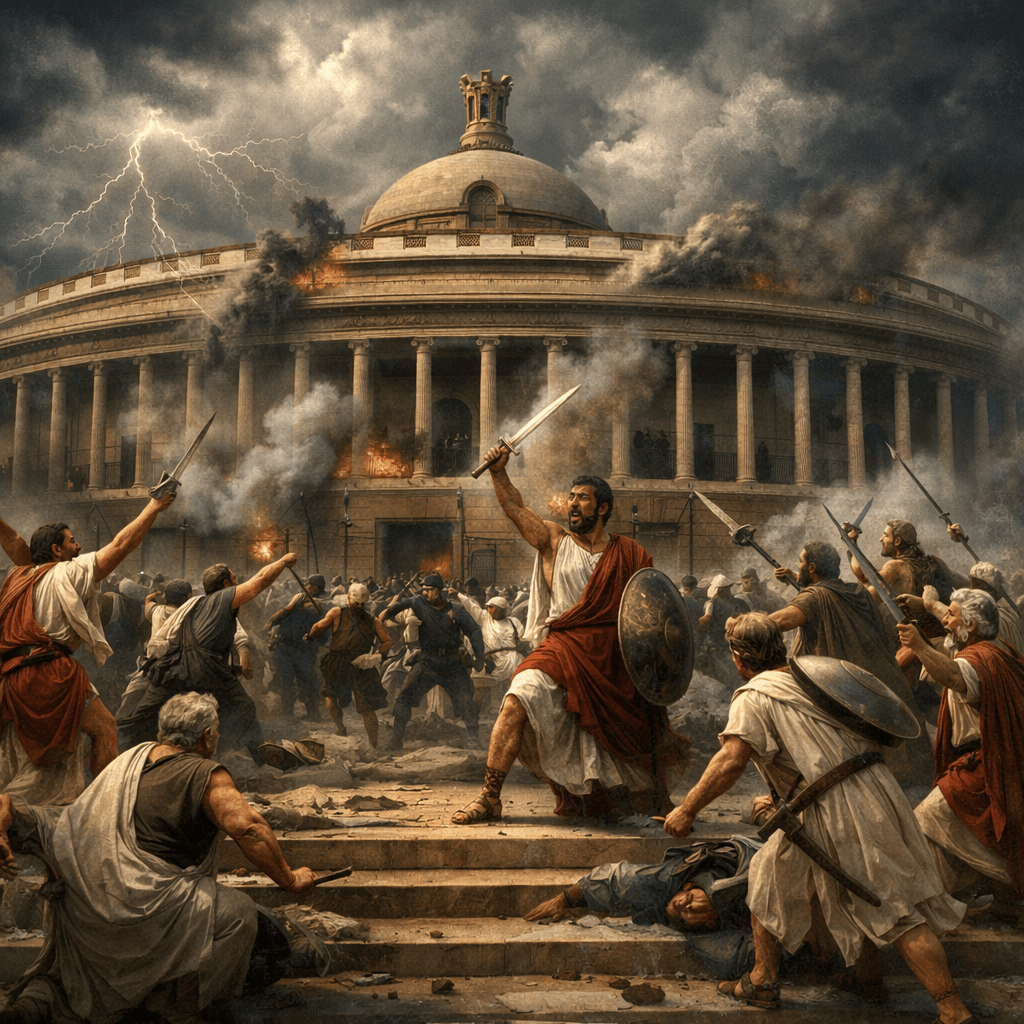
The early evolution of democracy in Athens was marked by both “birth pangs” and “growing pains.” Reforms initiated by figures like Solon and later expanded by Cleisthenes sought to curb aristocratic power and broaden political participation, but these changes often triggered resistance from entrenched elites and periods of instability, including tyranny and factional conflict. Even as democratic institutions such as the Assembly took shape, challenges persisted—limited citizenship, exclusion of women and slaves, and the volatility of mass decision-making. Thus, Athenian democracy emerged not as a smooth transition, but through struggle, experimentation, and continual adjustment.
During the formative phase of democracy in Athens, the lower classes—often likened to a “proletariat”—and various marginalized groups faced persistent inequalities despite political reforms. While leaders like Solon alleviated debt bondage and Cleisthenes expanded citizen participation, true power remained restricted to free male citizens. Poor citizens struggled with economic insecurity, as participation in public life required time away from labour, though later stipends eased this burden. Meanwhile, minorities such as metics (resident foreigners) contributed significantly to the economy but lacked political rights, and enslaved people formed a substantial, disenfranchised labour force. Women, regardless of class, were excluded entirely from political participation. These structural exclusions reveal that Athenian democracy, while innovative, rested on a narrow definition of citizenship and left large segments of society without voice or protection.
Democracy in Athens did not “mature” overnight—it evolved over roughly a century. Early reforms began with Solon around 594 BCE, but these were followed by setbacks, including the tyranny of Peisistratus and his sons. A more durable democratic framework emerged after the reforms of Cleisthenes in 508/507 BCE, which reorganized political participation. However, it was only by the mid-5th century BCE, under leaders like Pericles, that democracy reached its more “mature” form, with wider citizen involvement, pay for public service, and stronger institutions. So, from its early beginnings to a relatively stable system, the process took about 80–100 years—and even then, it remained imperfect and contested.
Postscript: A Glimpse from Fiction
In my dystopian novel, The Ashen Standard, freedom does not vanish overnight. It recedes quietly—justified in the name of order, accepted in the name of necessity.
But there is another danger: not only the overreach of power, but the overreach of perception. A society can begin to see tyranny everywhere, mistaking complexity for conspiracy. That tension feels familiar. India’s digital debate today sits between these two risks—complacency and alarmism. Neither captures the full truth. Democracies are not undone in a moment; they are shaped, gradually, by how they understand themselves.
.
Shankar Kashyap


Leave a comment