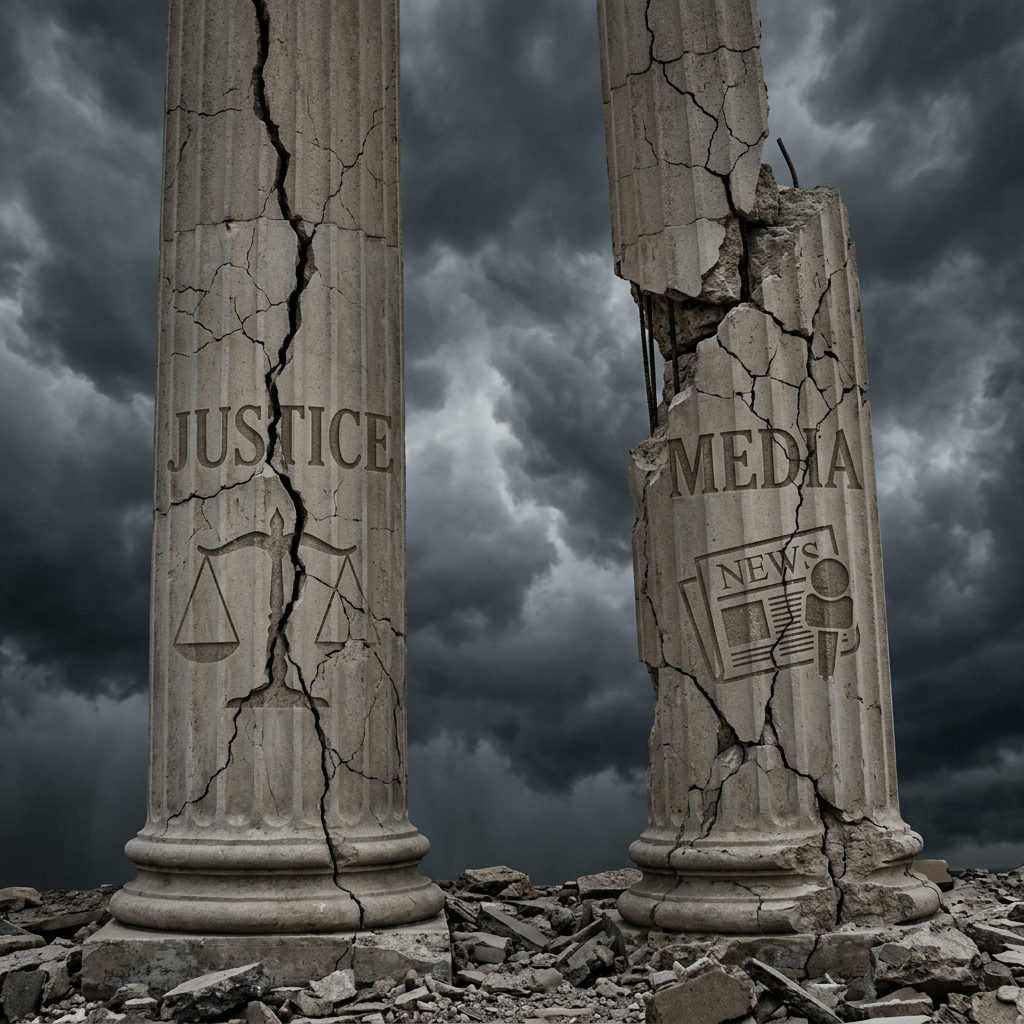

When Democracies Manufacture Their Own Tyrants
The distance between a crowd and its voice is often narrower than it appears.

Democracy is often described as the antidote to tyranny—a system designed to disperse power, elevate reason, and reflect the will of the people. Yet history presents a more complicated picture. Again and again, democratic systems have produced leaders who rise not by dismantling the system, but by mastering it—only to bend it toward personal power.
This paradox is neither new nor rare. It is, in many ways, a recurring feature of democratic life.
The Anatomy of a Demagogue
The term “demagogue” traces its origins to Ancient Greece demagoguery origins, where it described leaders who claimed to speak for the people while manipulating public sentiment. Figures such as Cleon demonstrated how persuasion could slide into provocation, and leadership into opportunism.
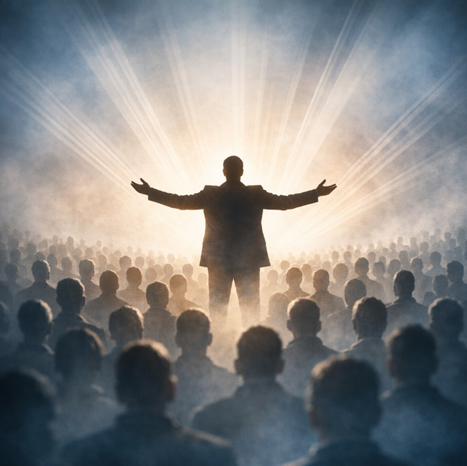
The essential traits have changed little over time:
- An appeal to emotion over reason
- The creation of enemies—internal or external
- A claim of exclusive representation: “I alone speak for the people”
- A gradual erosion of institutional norms
Demagogues do not typically reject democracy outright. They inhabit it, reshape it, and, eventually, dominate it.
Patterns Across History
Different eras, similar currents—grievance, certainty, and the pull of a single voice.
The pattern is remarkably consistent across centuries and cultures.
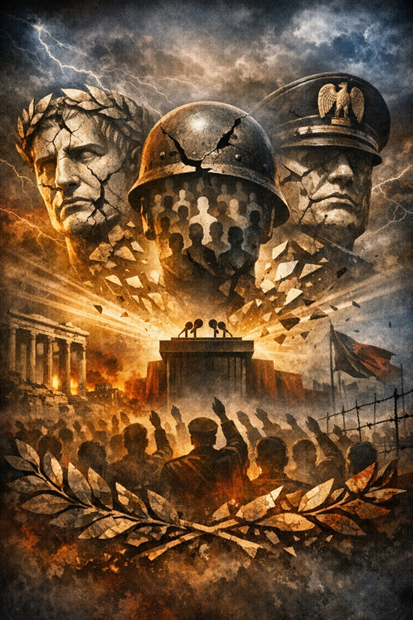
Julius Caesar rose through popular support, positioning himself as a champion of the people while accumulating unprecedented authority—marking the transition from Republic to Empire.
Adolf Hitler exploited economic despair, national humiliation, and fear to transform a fragile democracy into a totalitarian state—initially through legal means.
Benito Mussolini similarly leveraged post-war instability and a longing for national revival to consolidate power.
Even within stable democratic systems, figures like Huey Long demonstrated how populist rhetoric, combined with institutional leverage, could produce a near-autocratic style of governance.
Different eras, different contexts—yet the same underlying sequence: grievance, simplification, and the personalisation of power.
Why Do Demagogues Succeed?
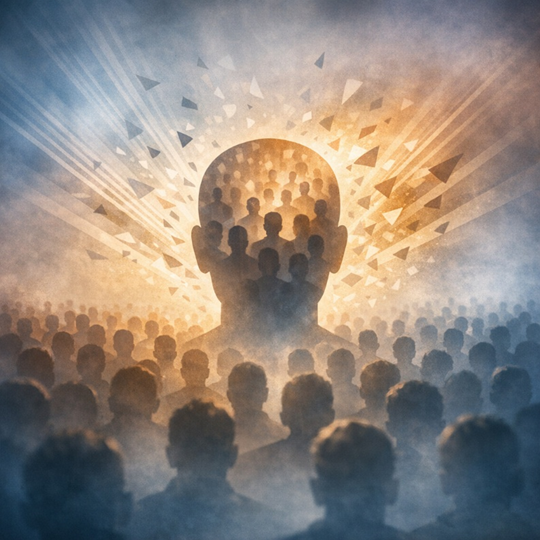
The crowd is not without reason—but it is not immune to emotion.
Their success is rarely accidental. It emerges from a convergence of conditions—political, psychological, and structural.
Crisis and Uncertainty
Periods of economic collapse, cultural anxiety, or geopolitical instability create fertile ground. In such moments, complexity becomes intolerable. Certainty—even if false—becomes attractive.
Emotional Mobilisation
The idea of “mass hypnosis” is often invoked, but it misleads. Populations are not hypnotised; they are persuaded under pressure. Emotions—fear, pride, resentment—are amplified and directed.
Psychological dynamics such as Groupthink and Confirmation Bias reinforce existing beliefs, making dissent feel not just wrong, but disloyal.
Narrative Simplicity
Complex problems are reduced to stark binaries:
- Us versus them
- Strength versus weakness
Solutions are personalised:
Only one leader is presented as capable of restoring order.
Media Amplification
From radio broadcasts in the early twentieth century to today’s algorithm-driven platforms like Facebook and X (Twitter), repetition and reach transform rhetoric into perceived reality.
The Educational Fault Line

Knowledge may be taught; judgement is rarely examined.
It is tempting to attribute the rise of demagogues to ignorance alone. That would be too simple—and too comforting.
Modern democracies often produce technically educated citizens yet neglect civic reasoning. Voters are taught how institutions function, but not always how to critically evaluate those who seek to control them.
Rhetoric, logical fallacies, and the mechanics of persuasion receive little attention in formal education. The result is a paradox: a system that is procedurally robust, yet intellectually vulnerable.
A democracy may know how to count votes. It does not always know how to weigh arguments.
The “Virtual Dictator” Within Democracy
Power rarely arrives fully formed—it accumulates, often unnoticed.
The most striking feature of modern demagoguery is not its violence, but its subtlety.
Power is rarely seized outright. It is accumulated—incrementally, often legally.
- Judicial independence is questioned, then constrained
- Media credibility is undermined, then bypassed
- Electoral norms are tested, then redefined
All this can occur without the formal collapse of democratic structures. Elections continue. Institutions remain—at least in appearance.
What emerges is something more ambiguous: a system sometimes described as Illiberal Democracy, where the forms of democracy persist, but its spirit is diminished.
The dictator, in such cases, is not an external force. He is an internal evolution.
The Crowd: Not Hypnotised, But Overwhelmed
It is easy, in retrospect, to view entire populations as having been misled or deceived. Reality is more uncomfortable.
The crowd is not asleep. It is responding—to fear, to identity, to the human desire for order in uncertain times.
To dismiss this as irrationality alone is to misunderstand its power. It is, instead, a deeply human reaction—one that can be shaped, directed, and, at times, exploited.
Echoes in the Present
Contemporary democracies are not immune to these dynamics. Polarisation has intensified. Trust in institutions has eroded. Information ecosystems have fragmented into self-reinforcing loops.
The mechanisms are familiar, even if the tools are new.
The question is no longer whether democracies can produce demagogues. History has answered that decisively.
The more pressing question is whether they can recognise them in time.
A Quiet Convergence
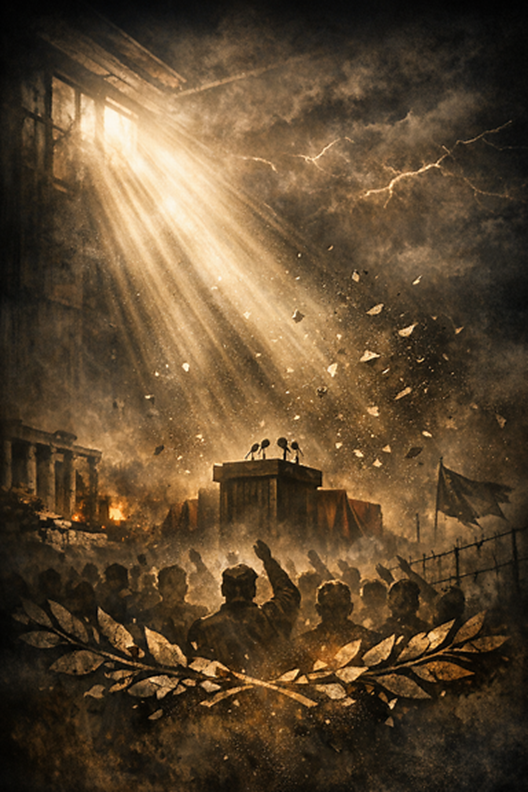
The most enduring transformations are often the least visible.
History and fiction often converge on the same uncomfortable truth: that the most dangerous rulers are not always those who seize power violently, but those who are invited in—quietly, even gratefully. In one imagined world, such a figure governs not through spectacle, but through patient erosion—rarely seen, seldom challenged, and ultimately unquestioned.
Conclusion
Democracies do not always fall to coups or revolutions. Sometimes, they are reshaped from within—gradually, procedurally, and with the consent of those who believe they are preserving them.
The danger lies not only in the ambitions of leaders, but in the conditions that make such ambitions acceptable. And those conditions, more often than not, are of our own making.
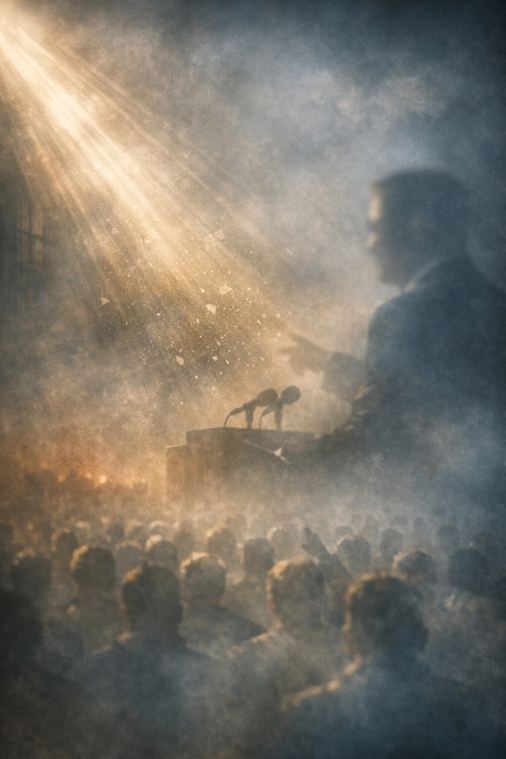
A system does not fail in a moment—it bends, slowly, in one direction.
For readers interested in a fictional exploration of these themes, my novel The Ashen Standard imagines a world shaped not by overt tyranny, but by something quieter—more gradual, and perhaps more unsettling.
A story of power that does not seize control—but quietly becomes it.



Leave a comment