


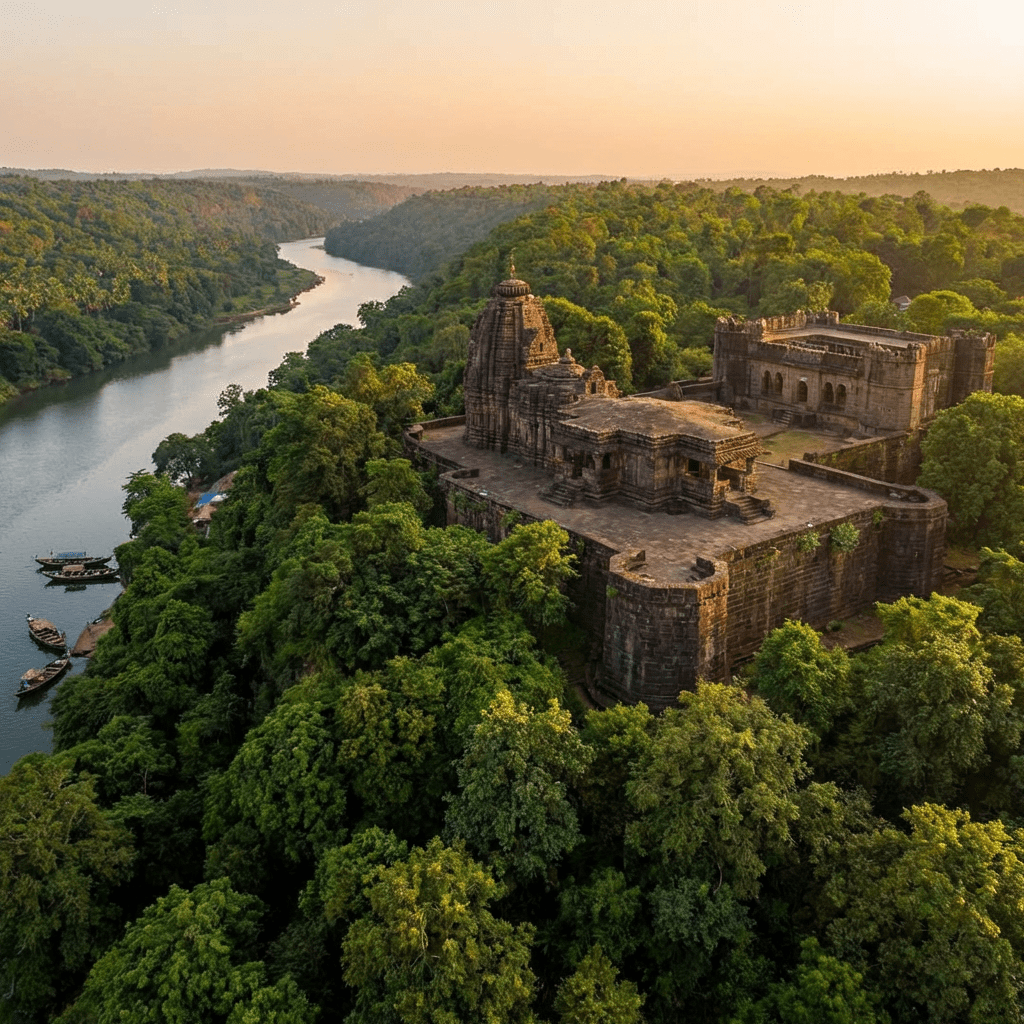
A forgotten kingdom, a doomed defiance, and the Jauhar at Anegondi
A Land on the Brink
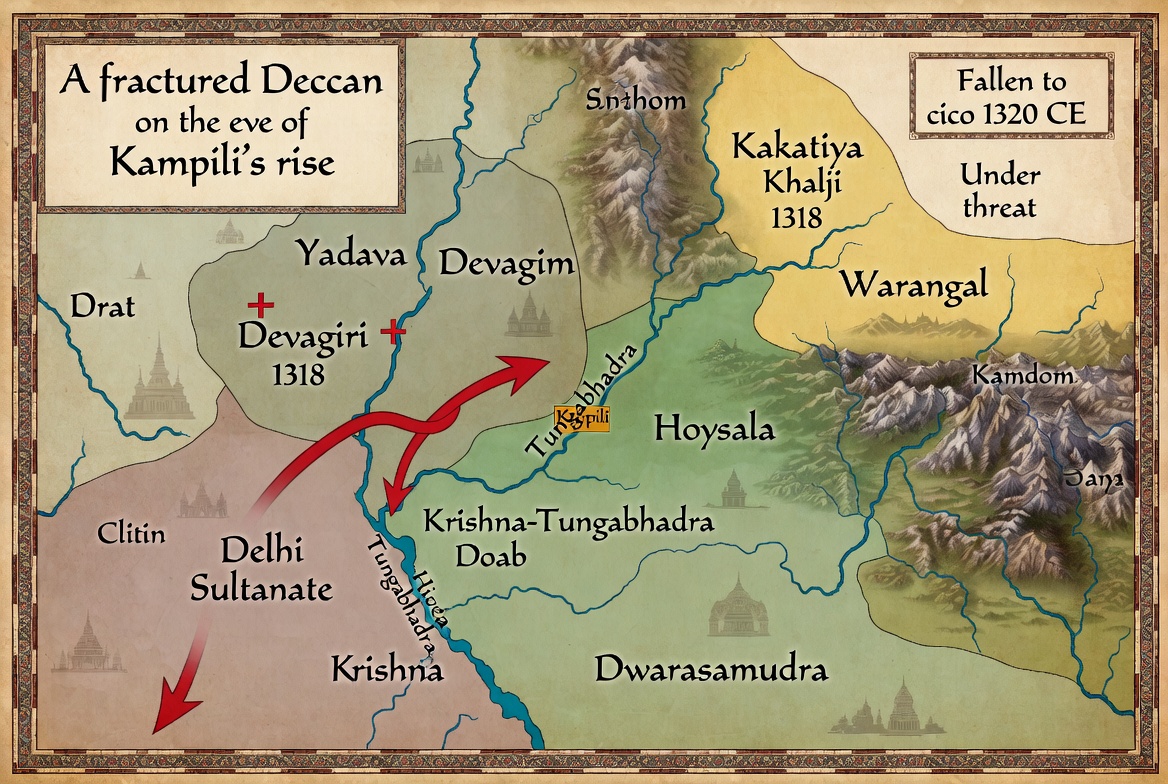
The early fourteenth-century Deccan was not merely unstable—it was unravelling at the seams of empires long accustomed to power. The once-mighty Yadava citadel of Devagiri (modern Daulatabad) had already crumbled under the hammer blows of Alauddin Khalji’s armies. In 1296, the sultan’s forces had stormed the fortress in a lightning raid; by 1318, the last Yadava resistance was extinguished, its treasuries plundered, its kings reduced to vassalage or oblivion. To the southeast, the Hoysalas of Dwarasamudra—renowned for their exquisite temples and refined court culture—felt the tightening grip of northern incursions. Their ornate halls trembled as Delhi’s governors probed deeper into the peninsula. Further east, the proud Kakatiyas of Warangal, masters of intricate stone carvings and fierce Telugu warriors, stood increasingly isolated after their failed rebellions. By 1323, even Warangal’s formidable fortifications had bowed to the Delhi Sultanate’s relentless pressure.
Hovering like a monsoon storm over this fractured landscape was the inexorable Delhi Sultanate. What began as raids under the Khaljis had evolved into systematic subjugation under Muhammad bin Tughlaq, whose ambition knew no geographical bounds. This was no mere territorial grab; it was the slow, deliberate extinguishing of a southern civilisation’s political order—its independent rajas, its dharma-driven kingships, its temples that doubled as centres of resistance and culture. The Deccan’s great powers were collapsing like dominoes; their sovereignty traded for tribute or annihilation.
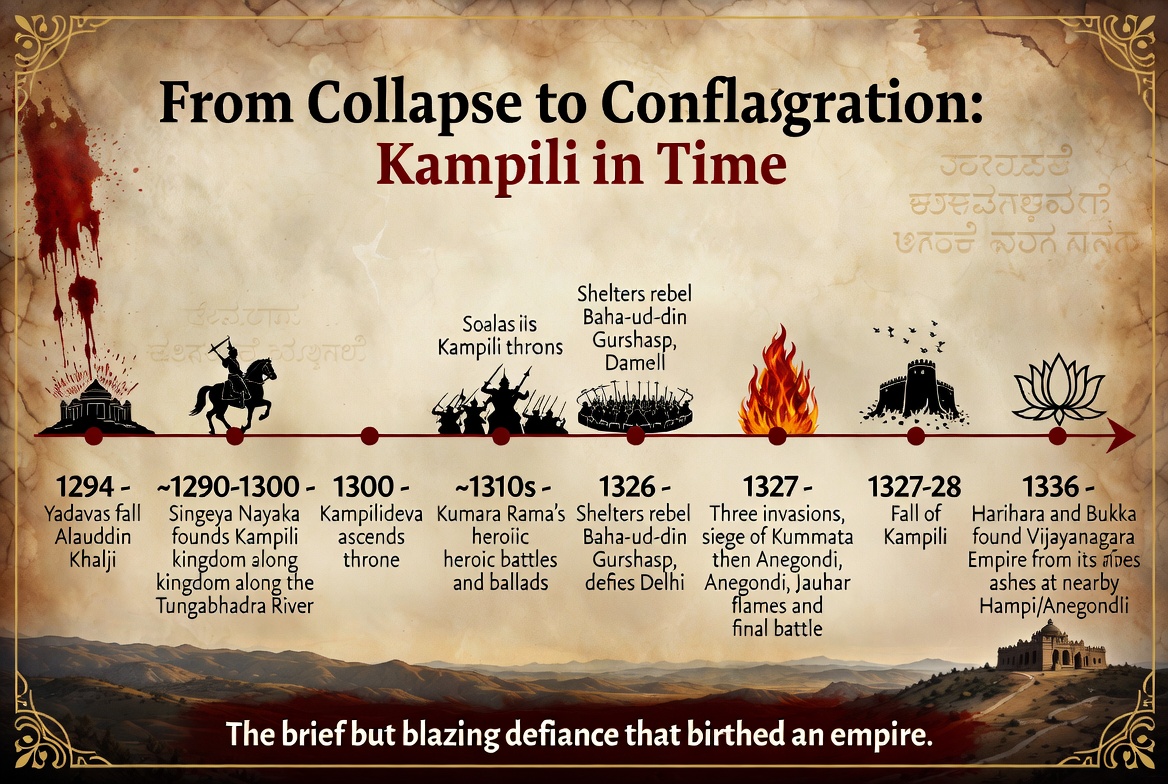
And yet, in the shadow of these dying giants, a small, defiant kingdom flickered into existence—not from grand ambition or inherited wealth, but from raw necessity and unyielding spirit. Kampili was never meant to rival the grandeur of Devagiri or Warangal. It was born as a last stand, a pocket of resistance carved from the chaos.
The Birth of Kampili: A Kingdom Against the Tide
The origins of Kampili trace not to a coronation in a gilded hall, but to the quiet determination of a battle-hardened soldier. Singeya Nayaka III—also known as Mummadi Singa—a seasoned commander in the service of the Yadava rulers of Devagiri, had witnessed the slow death of his overlords. When Alauddin Khalji’s forces shattered the Yadava realm around 1294–1318, Singeya refused to vanish into obscurity. Around 1290–1300 CE, he carved out a modest but strategically vital stronghold along the banks of the Tungabhadra River, near the historic site of Anegondi (about 20 km from what would become Hampi). This was the Krishna-Tungabhadra Doab, a fertile yet defensible corridor that had long served as a crossroads of trade and warfare.
It was no sprawling empire—merely a cluster of forts, loyal Nayaka chieftains, and warriors scattered from the ruins of larger kingdoms. Singeya’s polity drew strength from necessity: displaced soldiers, local feudatories, and a fierce commitment to Hindu dharma amid the rising tide of Sultanate incursions. He declared independence, leveraging the confusion following the Khalji conquests. By the time of his death around 1300 CE, the foundations were laid.
His son, Kampilideva (or Kampili Raya, Kampila Deva), transformed this fragile inheritance into a sovereign realm. Ascending the throne, Kampilideva ruled from roughly 1300 to 1327 CE. He did not pursue reckless expansion; instead, he fortified what he had—building strongholds like Hosamaledurga and even a Shiva temple on Hemakuta Hill in the Hampi region as a symbol of cultural continuity. Under his stewardship, Kampili became a beacon for those who refused submission. It sheltered remnants of Hoysala and Yadava loyalists and maintained uneasy alliances with neighbouring powers. Surrounded by the fading splendour of Dwarasamudra and the besieged grandeur of Warangal, Kampili stood not as a conqueror but as a guardian of the old order—small in size, immense in resolve.
Kumara Rama: The Lion of a Doomed Realm
If Kampili embodied defiance, then its prince, Kumara Rama (also revered as Gandugali Kumara Rama), was its living flame. Born around 1290 CE to Kampilideva, he was raised in the martial traditions of the Deccan—trained in sword, shield, horse, and the unyielding code of dharma. Kannada ballads and folk epics, still sung in Karnataka villages today, paint him as a hero cast in the mould of the Mahabharata’s Arjuna or the Ramayana’s Rama: youthful, fearless, and tragically fated for immortality through sacrifice rather than victory.
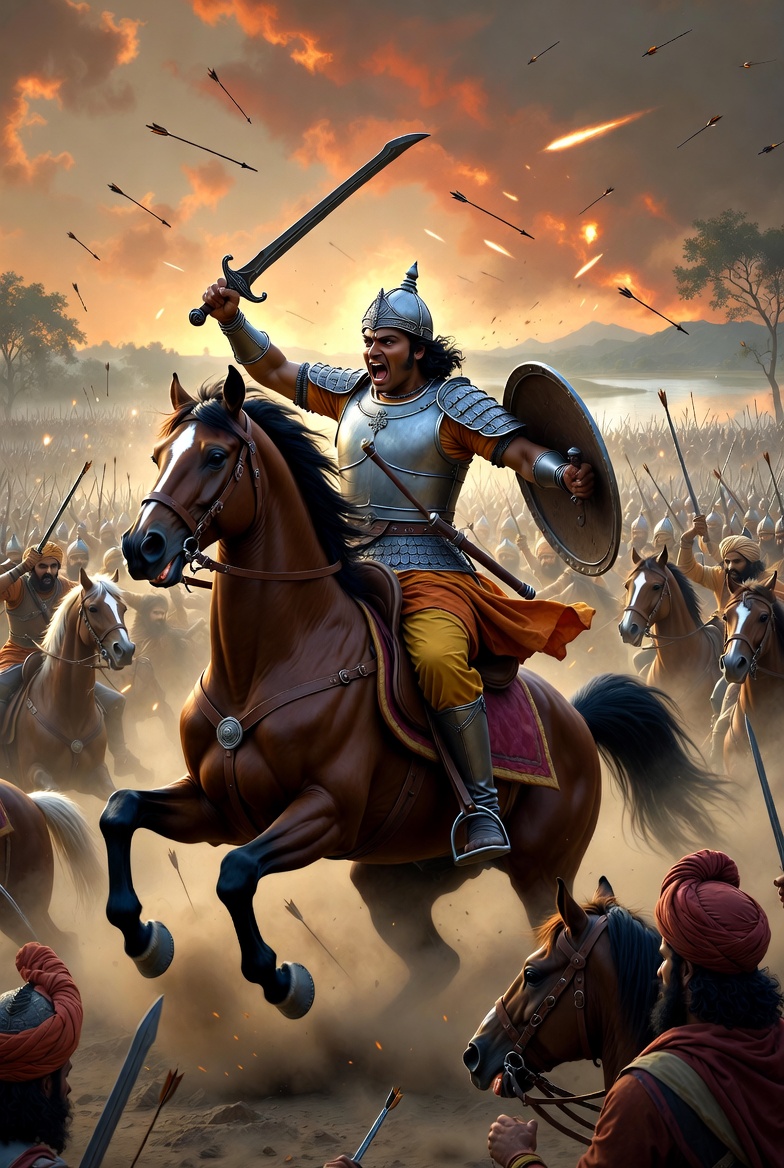
Legends speak of Kumara Rama leading skirmishes from a tender age, his prowess earning him the title “lion” among warriors. He embodied not caution but pure, incandescent courage—riding into battles against overwhelming odds, his sword flashing like lightning over the Tungabhadra’s banks. One ballad describes him single-handedly turning the tide in border clashes, his voice rallying troops with cries that echoed the ancient epics. Though some traditions note he was passed over for direct succession in favour of stability, his role as protector and inspirer was unquestioned. He was not shaped for survival in a collapsing world; he was forged for a stand that would echo through centuries.
Kumara Rama’s story is not one of conquests tallied in chronicles but of refusal—to bow, to compromise, to let the light of southern independence flicker out without a fight. In him, the kingdom found its soul.
Intrigue, Refuge, and the Wrath of Empire
History often pivots not on brute strength but on principled choices—and Kampili’s choice proved both noble and fatal. In a gesture rooted in dharma and shrewd strategy, Kampilideva granted refuge to Baha-ud-din Gurshasp (or Garshasp), a rebellious cousin and governor who had fled the volatile court of Muhammad bin Tughlaq after a failed uprising. Sheltering a fugitive from Delhi was no small act; it was a direct provocation, a thumb in the eye of the Sultanate’s expanding dominion.
By the mid-1320s, the Deccan’s other powers had largely succumbed: Warangal had fallen in 1323, Dwarasamudra was crippled and soon to be absorbed. Kampili now stood virtually alone—a lone Hindu bastion in a sea of Sultanate governors. Tughlaq, brilliant yet ruthless, could not tolerate such open defiance. He dispatched armies not once, but three times. Kampili’s forces, under Kampilideva and the fiery Kumara Rama, repelled the first two invasions through guerrilla tactics and fierce loyalty of their Nayaka allies. But the third wave—massive, coordinated, and led by the Sultan’s best commanders—proved overwhelming.
The noose tightened around the kingdom’s heart.
The Siege of Anegondi: When Hope Burned
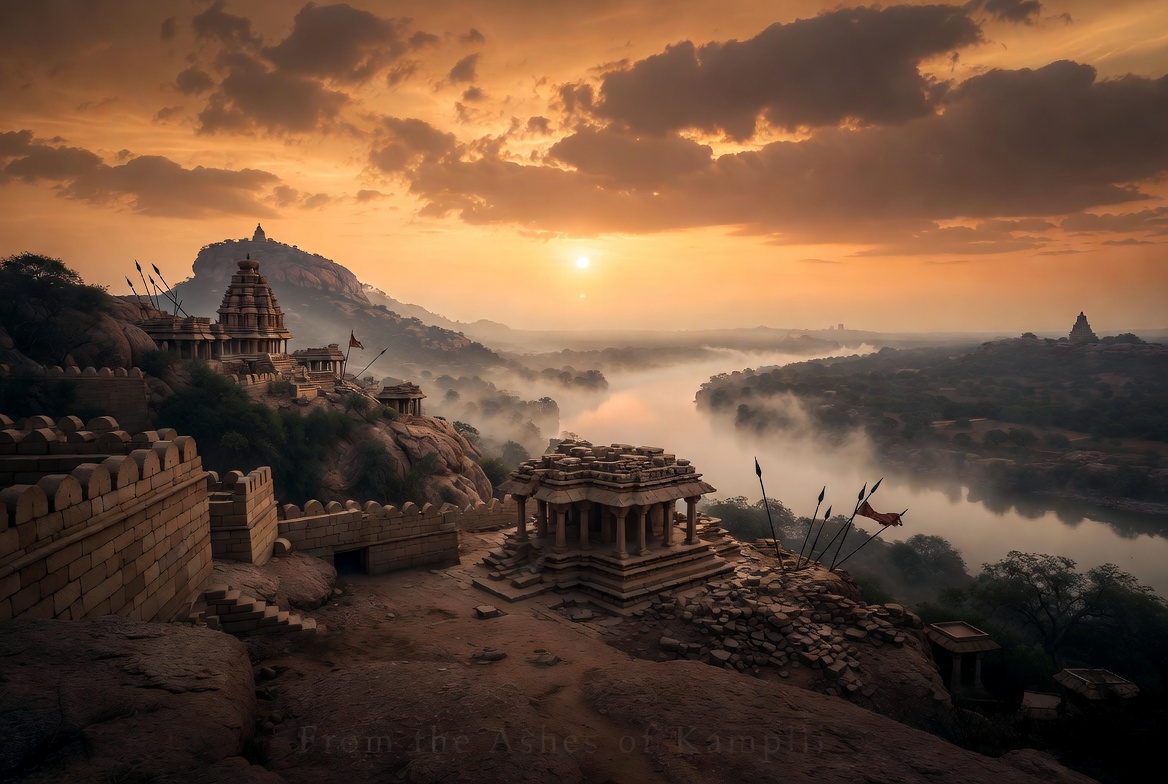
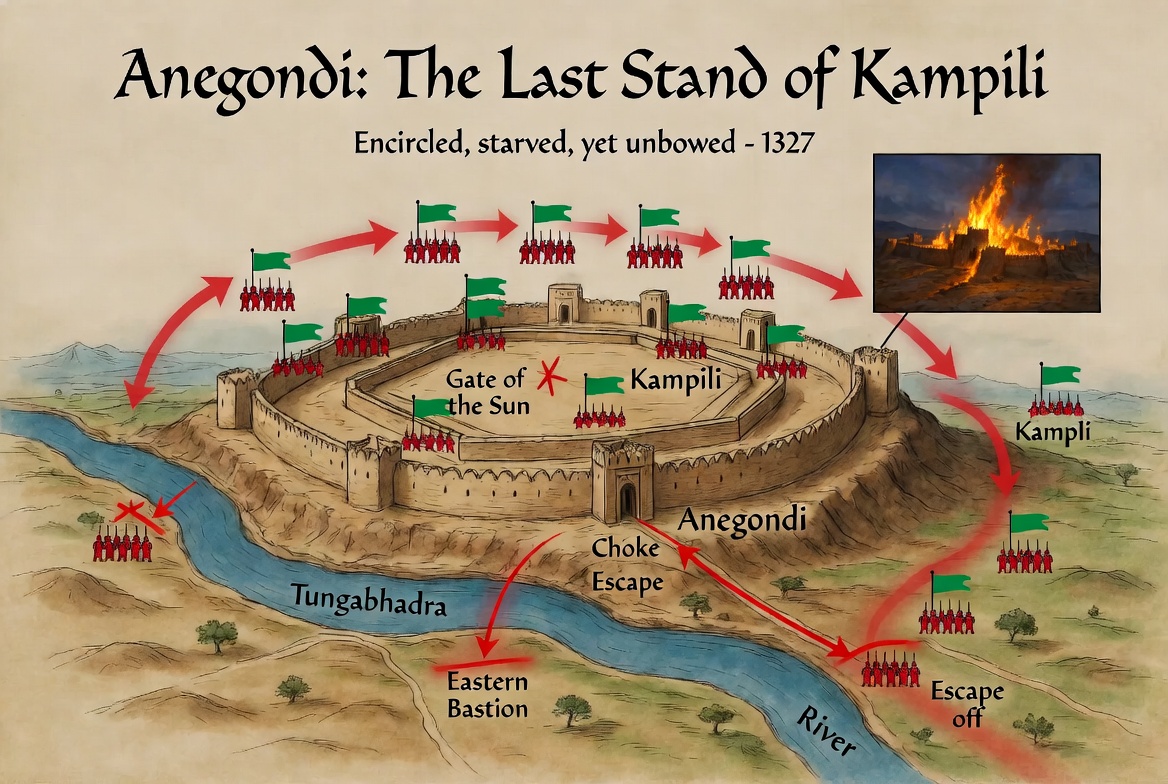
The final chapter unfolded at Anegondi, the fortified stronghold on the northern bank of the Tungabhadra. After initial clashes at Kummata, Kampilideva, Kumara Rama, their families, retainers, and surviving warriors retreated behind Anegondi’s walls. Tughlaq’s forces encircled them completely—no escape routes, no reinforcements, no hope of relief from distant allies.
Days stretched into weeks. Starvation gnawed at the defenders. Provisions ran dry. Yet surrender was unthinkable. In that crucible of desperation, the women of Kampili made a choice that history records with awe and sorrow: Jauhar. Rather than face dishonour, enslavement, or the violation that often followed conquest, they chose the purifying flames. Pyres were lit within the citadel. As the men prepared for their final sortie, the women—queens, princesses, wives of soldiers—walked into the fire with dignity, their sacrifice a transcendent act of agency in the face of annihilation.
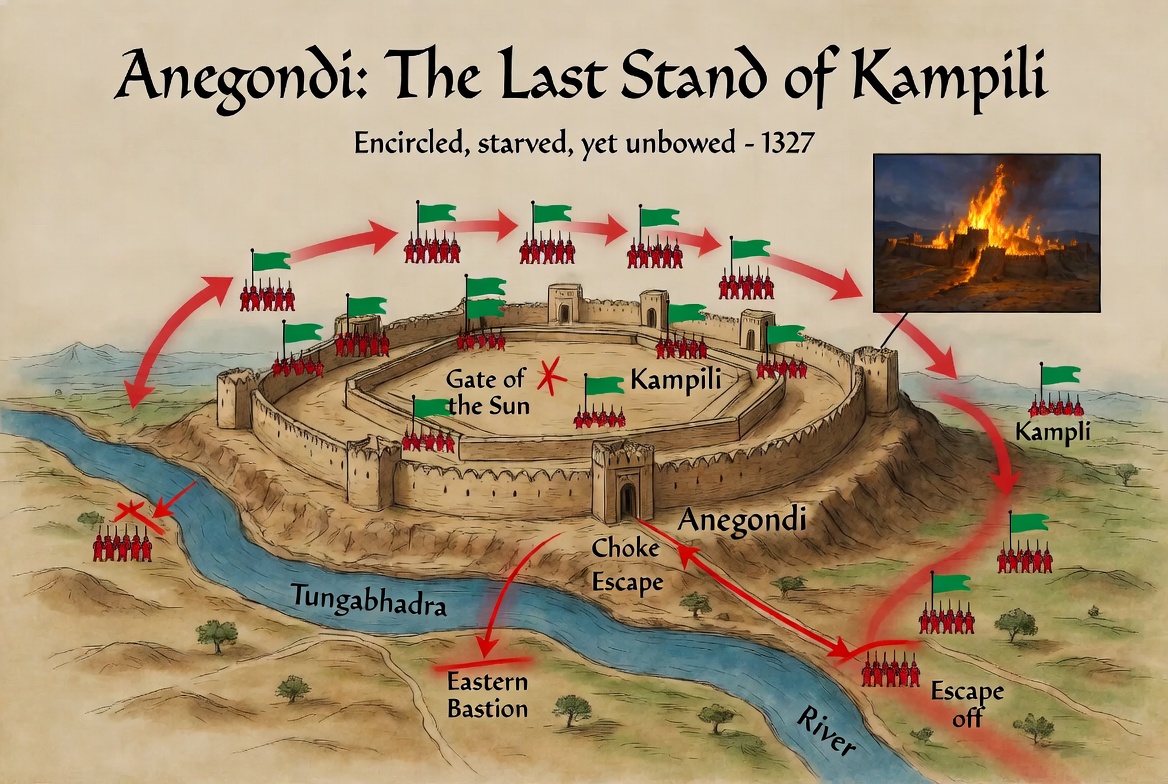
The men, led by Kampilideva and Kumara Rama, flung open the gates and charged into melee. Sword met scimitar in a frenzy of steel and blood. Kumara Rama fell fighting, his legend sealed in sacrifice. Kampilideva too met death refusing submission to the last. The flames did not merely consume; they liberated. This was no defeat—it was defiance etched in fire and steel.
The Fall: Death as Defiance
Kampili was extinguished in 1327–28 CE. Its warriors slain, its capital annexed, its people scattered or subjugated. The Sultanate claimed the Doab, installing governors and erasing the kingdom’s name from official edicts. Yet something intangible survived—the memory of unyielding honour. The Jauhar at Anegondi and the final charge became whispered legends, carried by survivors and bards across the Deccan.
From Ashes to Empire
History does not always crown the largest realms; it immortalizes the most unyielding. From the smouldering ruins of Kampili rose the ideological and political seeds of the Vijayanagara Empire. Harihara I and Bukka Raya I—the Sangama brothers—had served as ministers or officials within Kampili (having earlier ties to the Kakatiyas). Captured during the siege, they were reportedly converted to Islam temporarily and even appointed by Tughlaq as local administrators to restore order. But the flame of Kampili’s sacrifice ignited something deeper. Under the spiritual guidance of the sage Vidyaranya, they reconverted to Hinduism and, by 1336 CE, established an independent Hindu stronghold right there on the southern bank of the Tungabhadra—at the very site that would become Hampi, the heart of Vijayanagara.
Kampili did not vanish; it metamorphosed. Its defiance provided the moral blueprint, its warriors the inspiration, and its strategic geography the foundation for an empire that would dominate the Deccan for over two centuries, halting northern expansion and preserving southern dharma, art, and sovereignty.
A Story Retold
The tale of Kampili is no dry chronicle of dates and defeats. It is a profound meditation on honour, resistance, and the choices that define civilisations when darkness descends. In granting refuge, its ruler’s upheld dharma over expediency. In the Jauhar and final charge, its people chose transcendence over survival. Though forgotten by grander narratives of empires, Kampili’s brief blaze—lasting barely forty years—lit the path for Vijayanagara, which stood as a bulwark against further northern incursions for generations.
In “The Serpent and the Lion: The Song of Kampili”, I have sought to resurrect that silenced chorus—to give voice to the warriors who rode into eternity and the women whose flames outshone any conqueror’s torch. Not as mere history, but as a living song of fire and steel that refuses to fade.https://www.amazon.co.uk/Serpent-Lion-Kampili-Chronicle-Vijayanagar/dp/B0GJ3WWW3X/ref=sr_1_1?crid=4I464UQAB8IF&dib=eyJ2IjoiMSJ9.9LHSwQ30aW1wrWQtAJnT6Vj3z7c9_czEBmPhmbfBEVfnkWEIineLqoG5VRRHBa78FxAQdTJLu5L9yfFlNGotfP2QxVlTSOSqRtkm6-FaxINIuvcVw8cHpx2mjwCo-jBaUo3HdFO7aUL2rxmZhc2L4W65sZXWAlOSzvr5D3V95xKKvxL7D9CyNnY4MO4jQigQCDDDWqqG1JXJXUUmlhsclnpnC7qXkEtThI00itgj7RI.DyrSe_Nm0cccTzM9d-zSq1vx-yQiL5yIPz013bBKZ9k&dib_tag=se&keywords=serpent+and+the+lion&qid=1775501459&sprefix=serpent+and+the+lion%2Caps%2C261&sr=8-1
Kampili’s legacy endures in every Vijayanagara temple, every Kannada ballad, and every reminder that true victory sometimes lies in how gloriously one falls. In an age of shifting powers, its story whispers: some kingdoms are measured not by how long they stood, but by the light they cast before burning out.
 shankar kashyap
Leave a comment