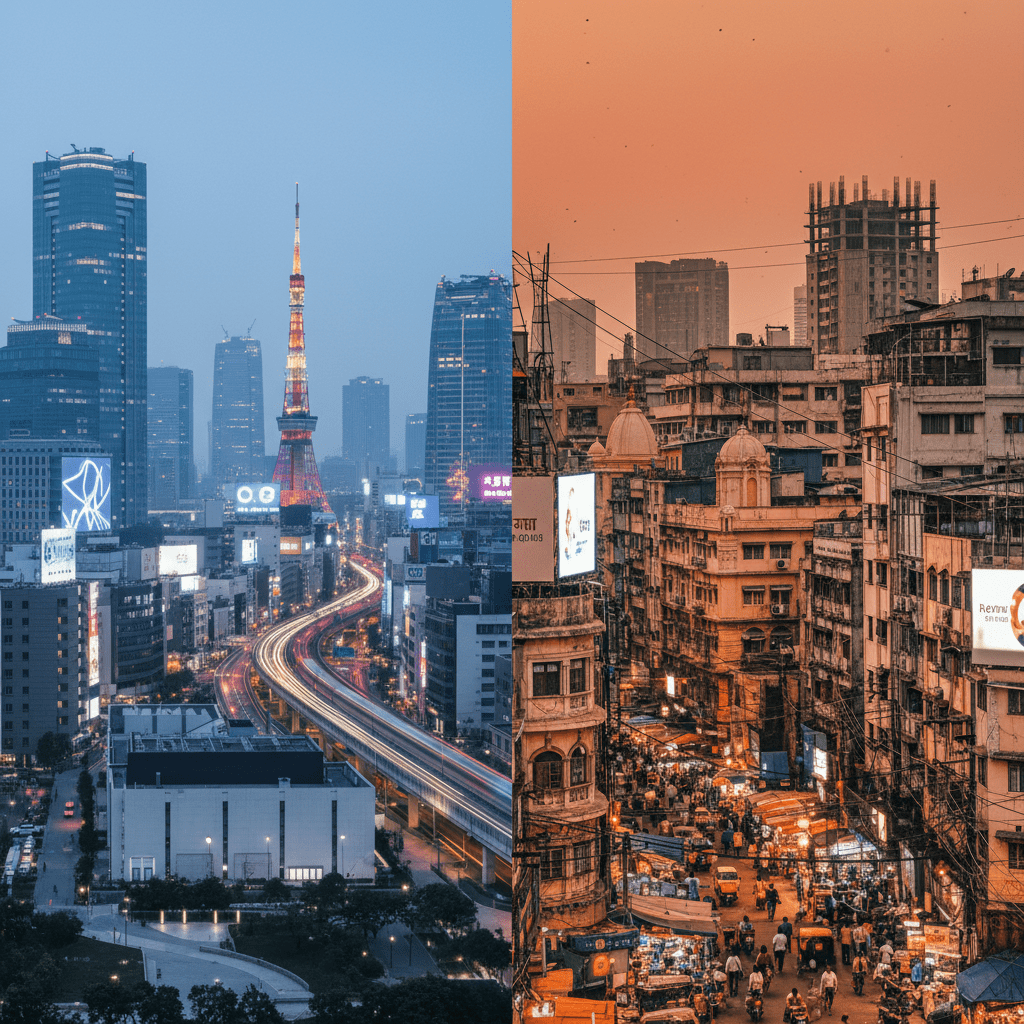

Prologue: Two Dawns
History rarely offers such neat symmetry, yet in the mid-twentieth century, two nations stood at the threshold of rebirth after profound upheaval.
In 1945, Japan lay in ruins—its cities reduced to ash after the devastation of war. Just two years later, in 1947, India gained independence, its soul unshackled from colonial rule but burdened by partition, poverty, and the immense challenges of nation-building.
This “Japan and India economic comparison” reveals how two countries, starting from vastly different foundations, charted divergent paths toward modernity. Both began anew, but the choices they made shaped profoundly different destinies in growth, human development, and national power.
The Weight of Beginnings
Japan’s destruction was largely physical—bombed infrastructure—but its institutions endured. High literacy preserved industrial knowledge, and a disciplined workforce provided a strong base for recovery.
India faced deeper structural challenges from colonial legacies: literacy below 20%, an overwhelmingly agrarian economy, fragile institutions, and deep social inequalities. Where Japan lost buildings and machines, India lacked foundational systems.
This initial divergence set the stage for the contrasting trajectories in the **Japan vs India economic journey**.
The Architecture of Growth
Japan rebuilt with precision and determination. From the 1950s to the 1970s, it pursued an export-driven strategy in automobiles, electronics, and precision engineering. Annual growth often approached 10%, supported by strategic state guidance that complemented private enterprise. Efficiency became a cultural hallmark.
India adopted a more cautious “mixed economy” under the “License Raj,” with heavy regulation and state-led industrialization. Growth hovered at a modest 3–4% annually—the so-called “Hindu rate of growth.” Only the 1991 economic liberalization crisis unlocked higher growth rates of 6–8% in subsequent decades. By then, Japan had already transformed into a global economic powerhouse.
Wealth and Its Illusions
Today, the “India vs Japan GDP” story carries striking irony. India has recently overtaken or closely rivalled Japan to become the world’s fourth-largest economy in nominal terms (around $4.2–4.5 trillion), reflecting its massive scale and rapid expansion.
Yet the lived experience diverges sharply:
– Average (per capita) income in Japan remains roughly ten times higher.
– Life expectancy stands at approximately 85 years in Japan, compared to around 71–73 years in India.
– Broader human development indicators show a similar gap.
India’s economic growth is vast but thinly spread across its population. Japan’s prosperity is dense and deeply embedded in everyday life.
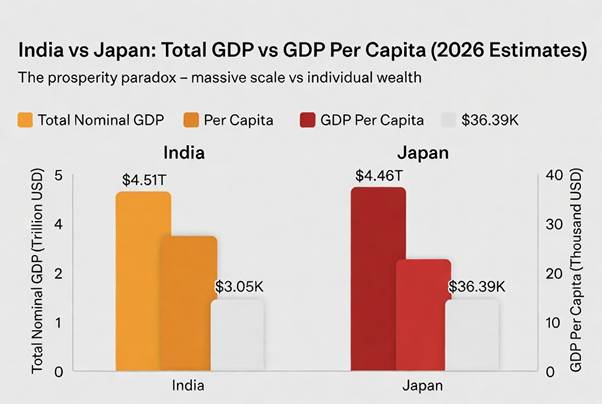
Chart 1: GDP vs GDP Per Capita (India vs Japan)
Data used (2026 estimates):
- Total Nominal GDP: India ≈ $4.51 trillion | Japan ≈ $4.46 trillion
- GDP Per Capita: India ≈ $3,050 USD | Japan ≈ $36,390 USD
This grouped bar chart clearly exposes the paradox: India’s massive aggregate economy nearly matches Japan’s, yet individual prosperity (per capita) remains dramatically lower.
The Human Question
Development ultimately concerns human lives, not just numbers.
Japan invested early in “human capital development”: universal education, accessible healthcare, and strong social cohesion. Results include near-99% literacy, exceptional longevity, and a profound sense of dignity in daily life.
India has made significant strides—literacy has risen to around 81%—but disparities by region, gender, and class remain. Healthcare access continues to improve unevenly, while malnutrition and inequality persist as challenges.
Japan built its people first. India is still striving to ensure equitable progress for all its citizens.
Labour, Land, and Transition
Sustainable transformation requires shifting labour from low-productivity agriculture to industry and services.
Japan achieved this rapidly. Agriculture now employs barely 3% of its workforce.
India remains more anchored in its past, with roughly 43–46% of the workforce still dependent on agriculture—much of it informal and low-productivity. This structural inertia continues to slow broader economic modernization.
Demography: A Tale of Time
Demography currently favours India.
Japan faces an ageing society with a shrinking workforce and rising dependency ratios.
India possesses a large, youthful population—a potential **demographic dividend** that could drive future growth.
However, without quality education, skills training, and job creation, this dividend risks becoming a liability.
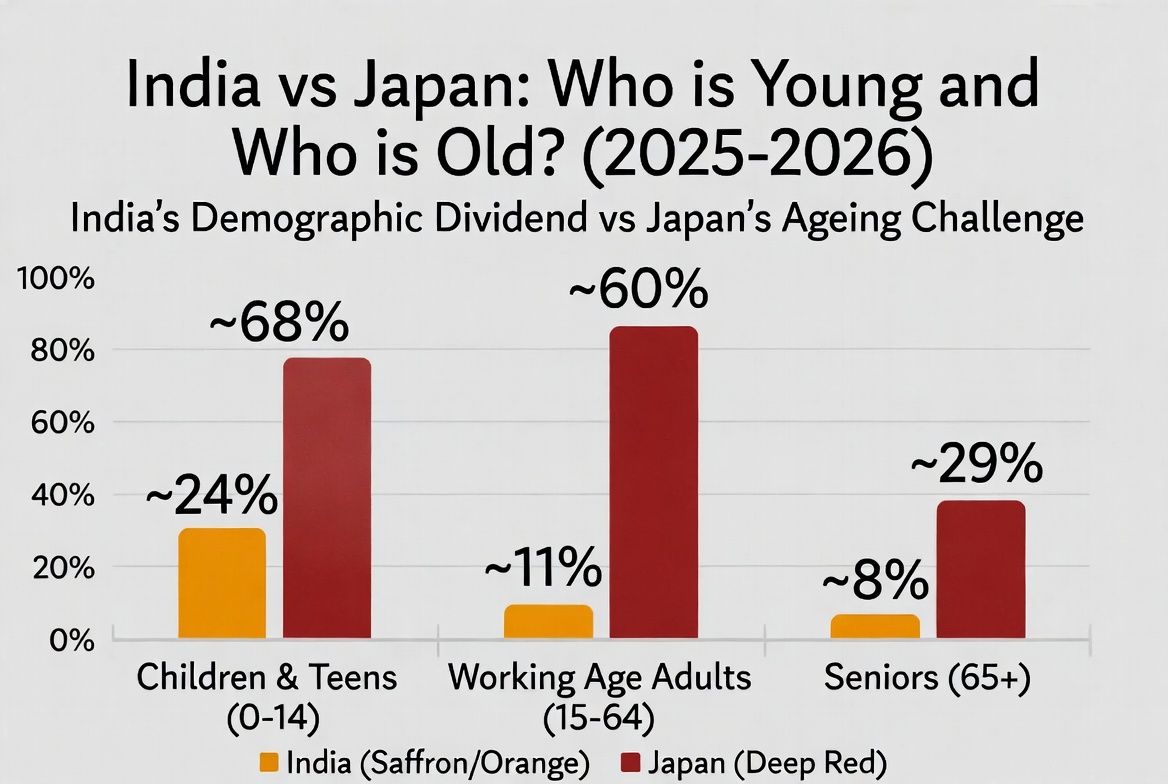
Chart 2: Population Age Structure (India vs Japan)
Data used (2025/2026 approximate percentages):
- India (youthful, broad base): 0–14 years ≈ 24–25% 15–64 years (working age) ≈ 68% 65+ years ≈ 7–8%
- Japan (ageing, top-heavy): 0–14 years ≈ 11% 15–64 years (working age) ≈ 59–60% 65+ years ≈ 29–30%
This side-by-side population pyramid comparison highlights India’s demographic dividend versus Japan’s ageing society.
The Invisible Hand of Institutions
Institutions often determine the pace and quality of development.
Japan benefited from administrative efficiency, policy continuity, and low corruption.
India’s vibrant democracy is resilient but frequently faces bureaucratic delays, policy inconsistency, and implementation gaps.
Strong institutions amplify good policies; weak ones can undermine even the best intentions.
Inequality: The Silent Divide
Japan’s postwar miracle created a broad middle class with widely shared prosperity.
India’s impressive growth has been more uneven, producing islands of affluence amid widespread deprivation. This dual economy—modern alongside traditional—highlights the risks of growth without sufficient distribution.
The Paradox of the Present
India stands on the cusp of equalling or surpassing Japan in total economic size. Yet the deeper question remains:
What is the true meaning of national power without widespread individual prosperity? A nation’s greatness ultimately lies in the well-being and opportunity it provides to its people.
Epilogue: Lessons Written in Time
Japan teaches that “human capital” is destiny—discipline, direction, and cohesion can compress decades of progress into years.
India demonstrates democracy’s complexity and resilience: slower and messier at times, yet capable of course correction and accelerating momentum. The deeper insight lies between them: Japan built prosperity as the foundation for influence. India is building economic and geopolitical power in pursuit of broader prosperity.
Their parallel journeys—from ashes and awakening—offer timeless lessons on development, governance, and the human dimension of economic transformation.


Leave a comment