


It started off as a gentle stroll over the vast sandy beaches of Marske-by-the-Sea and Redcar. The beaches here are unbelievably huge and clean with hardly any people. The sun was shining and warm, cooled down by a gentle breeze coming off the sea. The noise of an odd car passing on the marine drive was masked by the waves hitting the wave breakers out on the water. We could see the Huntcliffe massif in the distance standing like a sentinel against the sun. Gentle waves lapping on our feet, we could have easily walked for hours on the beach. This coast of North-Yorkshire and Cleveland is called the Jurassic coast for a reason. The beach is home for ancient fossils, and you do come across an interesting ammonite every now and then dating back to the Jurassic period when the giant dinosaurs ruled the earth. 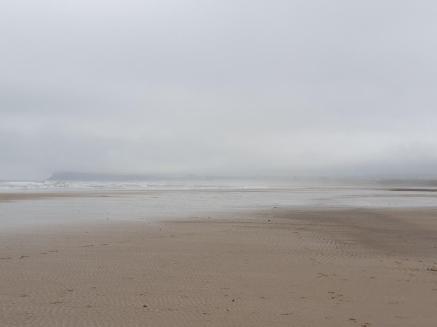
There is a small café just off the beach serving coffee and scones along with ice creams too. After a brief stop over for a cup of coffee, we set off for a 20 minute drive along a picturesque route that takes us into the North Yorkshire National Park and the small village of Danby. This quaint little village with stone built cottages is right out of a picture book, with its own tiny little station, church and post-office. I could almost see Postman Pat driving down his little red van through the narrow lanes. It is only a hundred yards past the village to the Moors National Park Centre. The weather turned a bit wet by the time we reached the car park which was nearly full despite the drizzle. The centre was hosting an exhibition by the artist– Debbie Loane. She is the ‘Artist in Residence’ for the Cleveland National Park.
The centre was sprawling stone built collection of buildings and a pleasant surprise once we were inside. It was like walking into a Tardis! Interconnecting corridors took us through several large rooms with displays of her work. From a small A5 sized paper to several large ca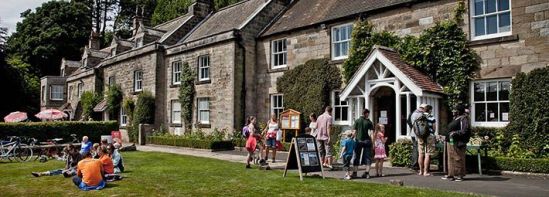 nvas pieces on the walls. Very tastefully displayed and impressive standard. The little pamphlet told us that she had walked the entire length of the Cleveland Way – all of 190 miles – over a period with her sketch book (which was also on display) for her material. She had used mixed media along with materials she had found in her walks along the Cleveland Way. Most of them were impressionistic work and I could see why she was so sought after artist. She had used vibrant colours to bring out the layers of the moors and the coast in the background. I was particularly impressed by her pieces on the cliffs of the Jurassic coast. It was very tempting to buy her work! We could have easily spent the afternoon browsing through the gallery.
The next stop would be to the Blue seals off Ravenscar. I had heard so much about the colony of Blue Seals but never had an opportunity to see them. The drive to Ravenscar – a 45-minute drive through some of the best scenic valleys and moors that I have seen – took us to Ravenscar Tea rooms. We parked in the nearly deserted car park wondering where was the beach. There were no signposts for the Blue Seals anywhere to be seen. A lady sitting on the bench with her dog was not of much help as did a couple of girl hikers who were also looking for the Blue Seals! We were sure the signs to Cleveland Way would take us to the beach and followed the signs. There were two paths, one quite well marked out and another one just off a tall hedge which was more of a rough path. We decided to take the rough path as it appeared closer to the sea. As we followed the path north looking for a break in hedge to lead us down the beach and the blue seals. Before long we saw a small break with a path leading up to it. There appeared to be a void beyond that and it was good thing that we stepped up to the edge of the break slowly. Our hearts sank at the sight. We were at the edge of a precipice with a seething roar underneath, probably around 500 to 600 feet below. We could not see the sea as it was covered by a fog bank trying to climb up the cliff. Disappointed, we worked our way back to the Cleveland way wondering what to do. May be there would be someone in the Ravens Hall we had passed on the way to the Tea rooms? Another half a mile of walking took us to the rather plush Hall, obviously once belonging to a rich family, now working as a venue for weddings and a Golf.
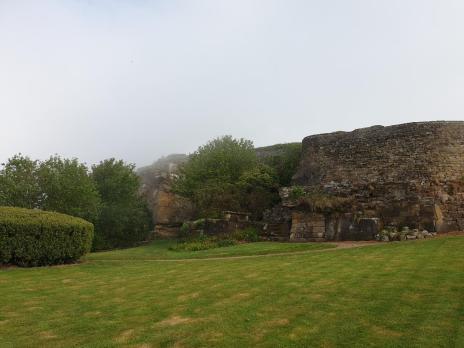
We had walked into the middle of a wedding with men and women dressed up in their finest sipping chilled pink champagne and G&Ts. The hotel/hall was obviously quite old and extremely ornate – half expected Hercule Poirot to pop out through one of the doors with his smelly cigars. The receptionist was very helpful and showed us the way to the beach and the Blue seals. It was by now time for an ice cream and coffee. After a delicious Ice cream and piping hot coffee we made our way to the side of the hotel and the path the friendly receptionist had asked us to take. Going through the walled gardens of the Hall took us to those period dramas you would see on TV and I expected a young couple to be courting on one of those stone benches any minute now. As the girl had said, we came across a narrow wooden door at the far end of the wall leading out to some stone steps and a vista you would die for. We were facing a vast well-manicured Golf course, with probably the best views of any golfer in the world. The vast green expanse of the green looked over the cliffs to the sea and the slope in some places must be challenging to any golfer.
We followed the path down towards the edge of the cliff looking for the way down to the beach. Still no signs for Blue Seals. Once we reached the edge of the cliff, we realised why. The path down to the beach is not for the faint hearted. Very steep covered mostly in tiny round gravel which is bound to slide you all the way down the precipice. There were a couple of places with wooden steps, but not many. They had kindly provided breaks in a couple of places down the path for old and infirm like me to rest! We could 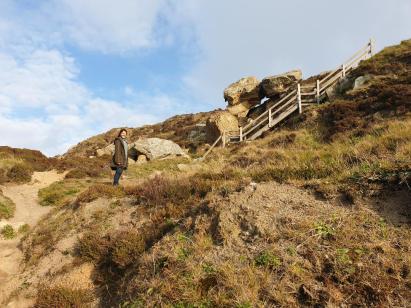 hear the roar of the sea but could not see the sea itself yet. When we did come to the end of the path to some rocky outcrops, it was well worth the effort of trying to kill yourself. The scene is out of this world. The school of Blue seals were playing in the waves around the rocky beach and some had climbed out of the water onto a narrow sand strip to sun themselves. Some were lying on rock and flipped over on to their backs as we watched. Really fascinating sight. The bark of the seals that could be heard over the roar of the waves sounded like an old dog.
 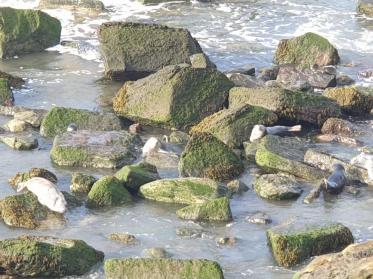 As we watched the waves the signpost at the top about a “Jurassic fault” became obvious. The waves broke in a large ‘V’ formation just off the shore. Apparently these fault were tectonic events during the Jurassic period when the earth splintered upwards. One surprising thing was that we did not see many sea gulls. The walk back up to the hotel was a lot easier, tiring, but easier and after stopping in a couple of spots ostensibly to take pictures.
Next point in our day was drive to the historical port of Whitby. I had heard of its attachment to Captain Cook but was surprised to see that it was also the place of Count Dracula. The author, Bram Stoker stayed in Whitby in late 1890’s and was inspired by the Abbey and the surroundings to create the iconic character an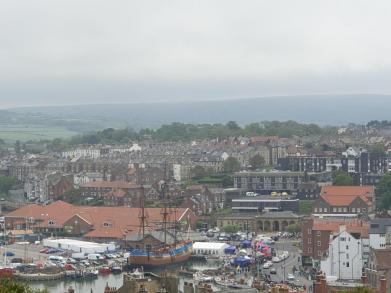 d novel, Dracula. We had walked into the annual “Fish and Ships Festival” and the place was packed. There were exhibitions, shows and fish cookery workshops on the quayside. The replica of Captain Cook’s ship, The Endeavour formed the centrepiece. Even today it is awe inspiring. I could see why and how the natives of Australia were intimidated by the sight of this elegant, but over-powering tall ship. The local fisherman were exhibiting their catch – huge monk fish, lobsters and fish I had never seen before.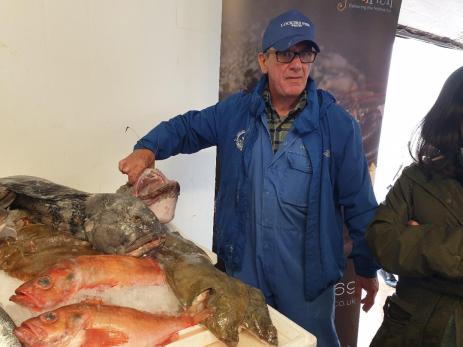
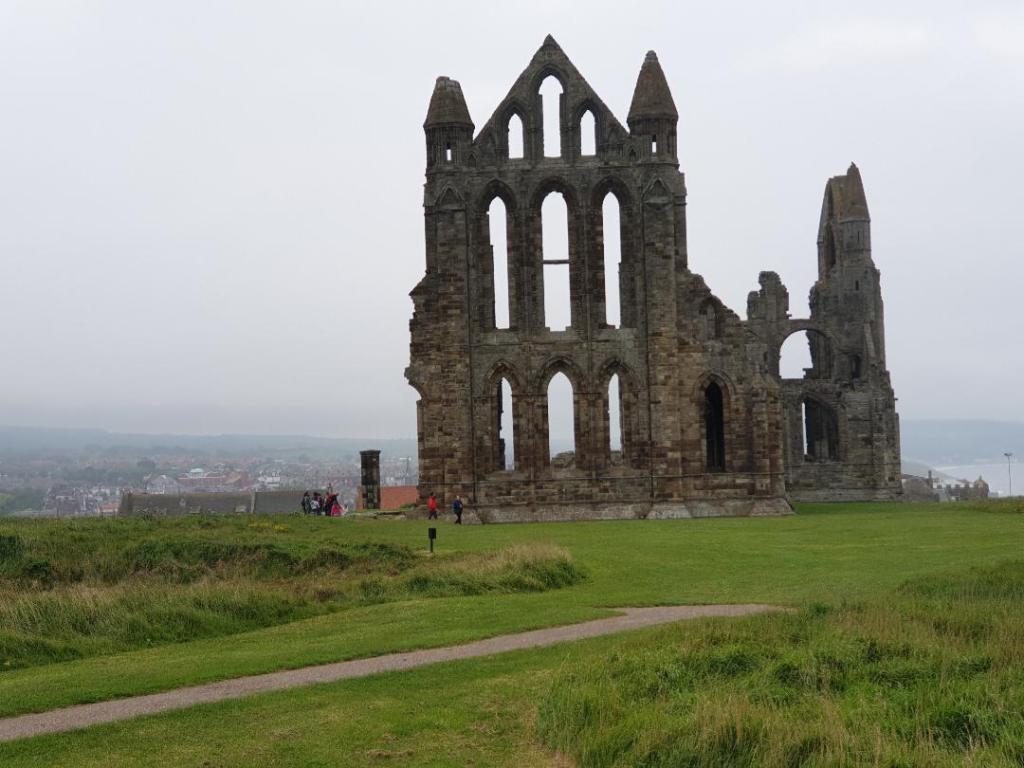
By this time, we were ravenously hungry – the Ravenscar climb had obviously used up thousands of calories of the lovely Ice cream from Rave Hall. The Magpie Café came highly recommended. There was a queue to get in despite the fact that it was well past lunch time. Built in 1750, the place was once a Pilotage and passed through a few sea merchants before becoming a restaurant. It had maintained the old world charm and served one of the best fish and chips I had tasted along with a great wine list and an impressive Gin list too. Eating ourselves full before attempting the climb to Whitby Abbey 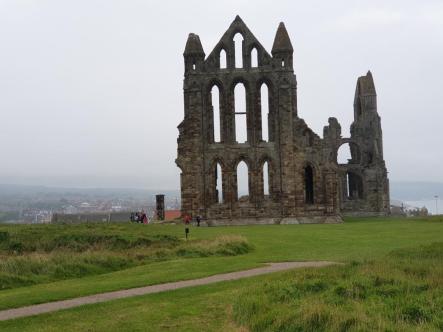 was probably not a very good idea. We had to cross a picturesque bridge across the Whitby harbour to reach the bottom of the steps going up to the Abbey ruins. Built in the 8th century as a Christian Abbey and later functioned as a Benedictine Monastery which was destroyed by the Danes during 9th century raids. It was rebuilt as another monastery only to be destroyed by King Henry VII in 16th century reformation. It was further destroyed by the German battle cruisers shelling during the first world war. The Cholmleys bought the site and built their mansion on the landward side of the abbey, ruins of which are now functioning as a museum. Climbing 199 steep steps to the Abbey on a full stomach is not recommended. We did not have time to go through the museum. There is still a functioning church next door with an ancient graveyard dating back to 17th and 18th century.
 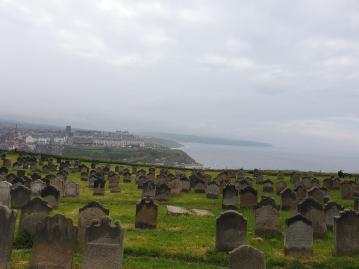 The graveyard would give you the creeps, limestone grave stones, darkened by hundreds of years of exposure, in various states of disrepair. One could easily understand how the area, with grey ruins of the abbey with equally eerie graveyard would give Bram Stoker he needed to create Count Dracula.
By this time the sun was going down in the west and the birds were calling time. We headed back down t the harbour, satisfied that it was a great day out. The narrow streets of the fishing village is no a thriving community with numerous shops selling everything from Whitby rock to Whitby Jet. Almost every other shop was selling jewellery, claiming to sell a genuine Whitby Jet. This is a fascinating gemstone and the name ‘Jet black’ comes from Whitby Jet. It is perfect black with no tinge of any other colours as the gem absorbs all visible spectrum of light. Apparently Queen Victoria asked her jewellery to be made, even for her crown, using nothing but Whitby Jet after the death of her consort, Alfred. It is not really a stone – it is fossilised wood compressed over millions of years – again dating back to the Jurassic period. And it is not cheap.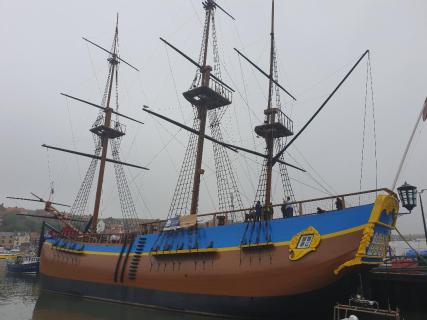
The drive back across the north Yorkshire moors with the heather still grey between light grass and against a setting sun was again a visual treat. The moors get transformed into purple and violet admixed with bright yellow and green grass during August – artistry of nature cannot be beaten by mortals.
Jurassic coast
The vast moors stretch as far as the eye can see
Broken by a valley or two on the way to the sea
The land has been here since the day of the Dinosaurs
It is humbling to follow the footsteps of mighty Dinosaurs
The beauty of the cliffs and the ocean waves, mind can see
The cliffs are mighty and awe inspiring, as were the Dinosaurs
It is our blessing that we have eyes and mind to enjoy and see
The beauty is for everyone to see, him, her; not just theirs or ours.
The moors covered in grey and yellow with the road winding
In the middle of an unending vista of hills, valleys and streams
The beauty is every where to be seen, does not take much finding
The Jurassic coast beckons to you, stay with you in your dreams
Shankar Kashyap


 shankar kashyap
Leave a reply to Meena Mishra Cancel reply