


This is the week when the creator of Facebook, Mark Zukerberg floated his company on the stockmartket to become one of the richest men in the world and get married. I am sure he would be surprised to find someone else had thought of it 6000 years ago!
Now archaeologists have found rock paintings in Russia and Sweden depicting what could be the earliest version of Facebook. Granite rocks in Russia and northern Sweden reveal a timeline filled with an archaic version of the Facebook “like.”
Using computer modelling, Mark Sapwell, a Ph.D. archaeology student at Cambridge University analysed some 3,500 rock art images from Nämforsen in Northern Sweden and Zalavruga in Western Russia.
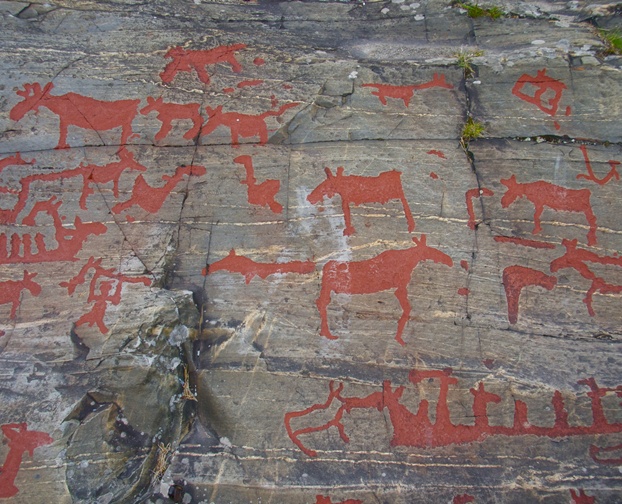
A cluster at Nämforsen called Lillforshällan, where the elk image is the most common star of the show. This cluster is dated to an early period, around 4000 BC, when the elk image was the most common image to use. Credit: Mark Sapwell
Carved from about 4000 BCE up to the Bronze Age, the rock art shows animals, people, boats, hunting scenes — even very early centaurs and mermaids. Generations of semi nomadic people, who lived further inland in winter to hunt elk, produced these images and then occupied areas closer to coasts and rivers to fish.
As they were located in central and prominent locations on river crossroads, the rock art landscapes were likely very visible points where passing travellers would take notice of drawings by the people who came before them, adding their own images – “Like” on the world. These paintings were on a series of clusters over a period of time – may be indicating they had Twitter as well – a popular Elk image being followed!!
Usually clustered on the granite rocks, the images ranged from groups of one to two images to rock art panels with over 500 images. Larger clusters represented a greater response and dialogue between people or may be a famous Bronze Age star being followed!
Images involved in those clusters were the most popular or most discussed for that time. For example, in earlier periods (around 4000-3500 BCE), a silhouette form of elk image is almost always seen among large clusters and rarely alone. The popularity of images changed over time just like fashion changed over time on Facebook. Only the latest fashion gets most “Like” hits!!
According to Sapwell, the vast natural canvases attracted so much attention because, the early Bronze Age people understood their social network power.
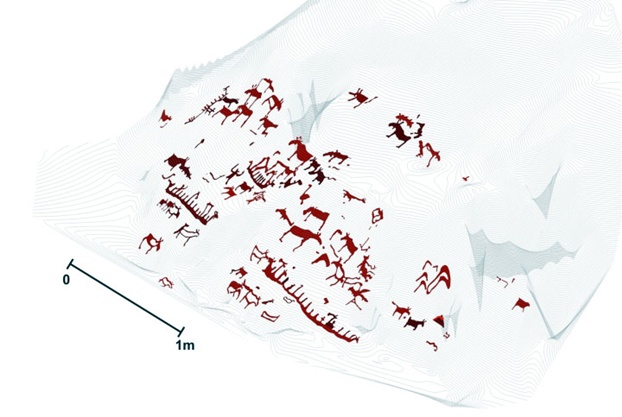
This is a computer model showing cluster of rock paintings showing the “Like” hits!!
Like today, people have always wanted to feel connected to each other and this was an expression of identity for these very early societies, before written language.
Mark Zuckerberg can take comfort in the fact that it never caught on!! They seem to have died out with the Rock paintings.


 shankar kashyap
Leave a reply to shankarkashyap Cancel reply