



A 2,500-Year Pattern—and Its Limits
Why history explains recurring hostility toward Jewish communities—but cannot justify modern violence
History records a striking pattern: across vastly different civilizations, political systems, and eras, Jewish communities have repeatedly been marginalised, expelled, or persecuted. From the Babylonian exile in the 6th century BCE through Roman antiquity, medieval Christendom, Islamic polities, Enlightenment Europe, and into the 20th century, the word “persecution” appears with unsettling regularity. Historians have catalogued hundreds of local expulsions, pogroms, and massacres—England in 1290, Spain in 1492, Russia in the Pale of Settlement, and Nazi-occupied Europe being only the most infamous.
The question is unavoidable: why does this pattern recur?
Origins: Identity and Separation
And more importantly: does history explain anything about the conflicts we see today?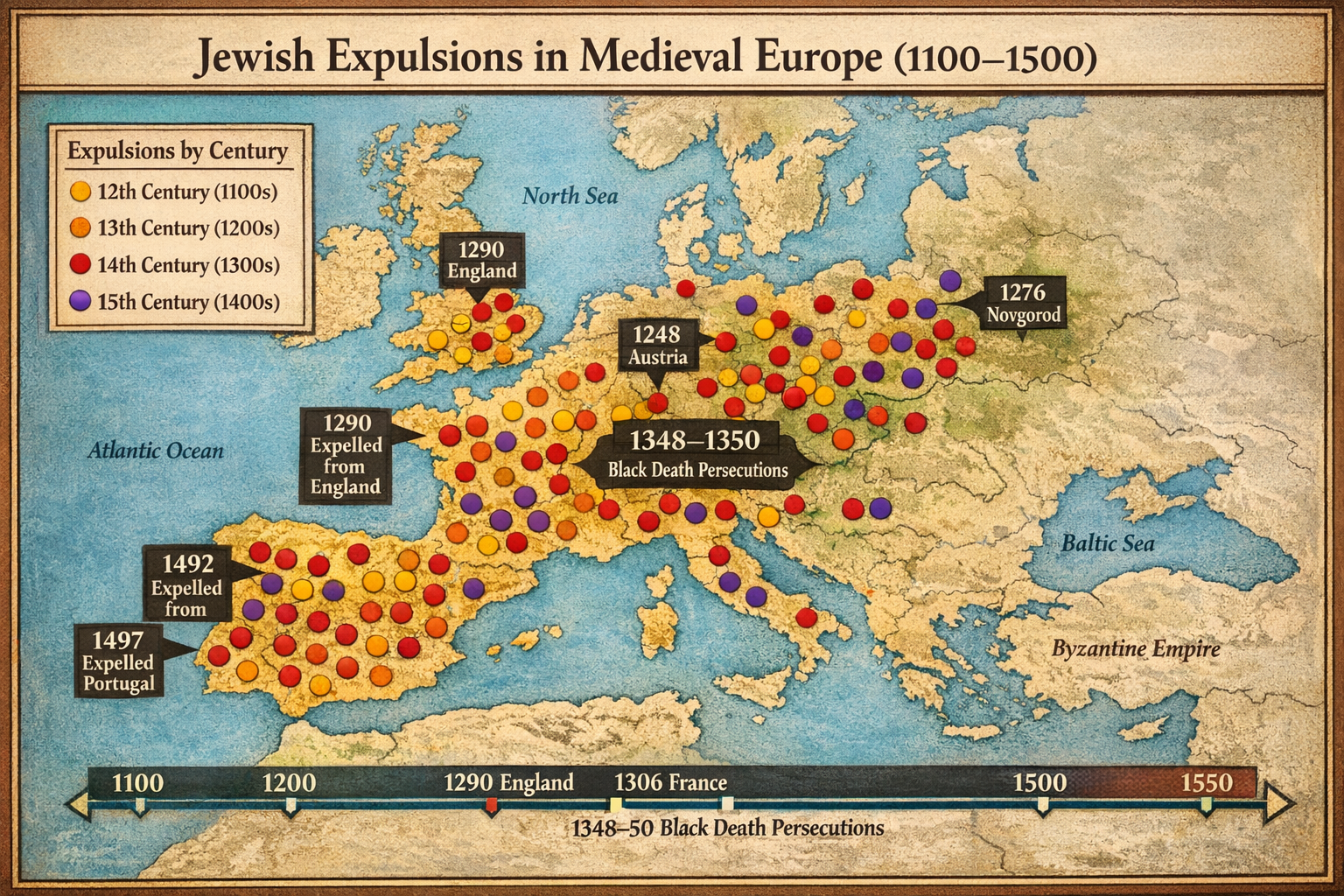
The pattern begins with a deliberate act of self-definition. In the late 7th century BCE, during the reign of King Josiah of Judah, a sweeping religious reform—described in the biblical Book of Deuteronomy—centralised worship in the Temple in Jerusalem, purged competing cults, and codified a written legal and ethical code that emphasised covenantal distinctiveness. This was not mere ritual; it created a portable, text-based identity that could survive exile and dispersion.
That identity produced two enduring consequences: – “Internal cohesion”: Shared law, calendar, language (Hebrew for liturgy), and narrative of chosenness fostered remarkable resilience. Jewish communities could maintain continuity across continents and centuries without a state or army.
Visible separation: In multi-ethnic empires (Persian, Hellenistic, Roman), practices such as dietary laws, Sabbath observance, circumcision, and refusal to participate in imperial cults marked Jews as “other.” Difference was not invented by outsiders; it was chosen and maintained by the community itself as a survival strategy.
Under Roman rule this friction became explosive. The Jewish Revolt of 66–73 CE and the Bar Kokhba revolt of 132–136 CE were not simply religious wars; they were also contests over taxation, governance, and cultural autonomy. Rome crushed both with characteristic brutality, destroyed the Second Temple, and renamed the province Syria Palaestina. The resulting diaspora scattered a people whose identity was already portable—and therefore both durable and noticeable.
***
Theology and Suspicion
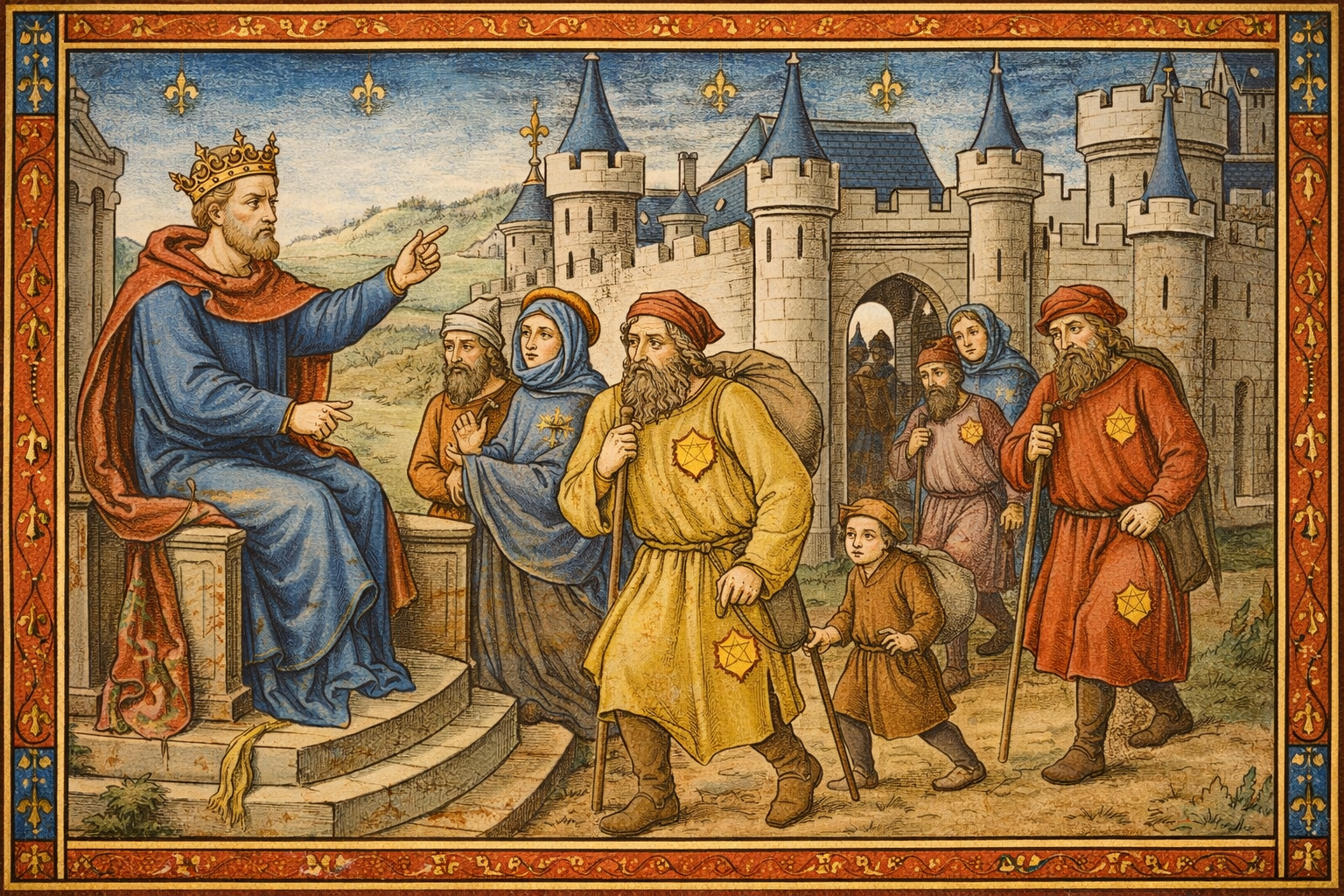
The rise of Christianity transformed difference into theological opposition. Early Church fathers, most influentially Augustine of Hippo (4th–5th centuries CE), developed the doctrine of the “witness people”: Jews must be preserved in a subordinate state as living proof of Christian supersession. Their dispersion was interpreted as divine punishment for rejecting Jesus, yet their survival as a people was necessary to fulfil prophecy. This theological scaffolding hardened over centuries into institutional reality:
– Legal codes (Theodosian Code, later medieval canon law) barred Jews from owning land, joining guilds, or holding public office.
– Periodic violence erupted during crises—Crusader massacres in 1096, the Rhineland pogroms, and the 1348–49 Black Death accusations of well-poisoning that killed thousands.
The blood libel (the fabricated claim that Jews murdered Christian children for ritual purposes) first appeared in Norwich, England, in 1144 and spread across Europe. It was not random prejudice; it was a narrative that turned economic or social tension into existential horror. In times of plague, famine, or war, a visible, non-assimilating minority became the safest target for redirected rage. The mechanism is depressingly universal: fear seeks a face.
***
Economic Roles and Resentment
Medieval Christian doctrine forbade usury (lending at interest) among Christians, yet permitted it toward non-Christians. Combined with exclusion from most trades and landownership, this channelled many Jewish communities into moneylending, tax-farming, and long-distance trade. These roles made them indispensable to kings and nobles—yet also uniquely exposed when debts mounted or harvests failed.
The pattern repeated:
– A minority occupies an economic niche that the majority cannot or will not fill.
– Success in that niche is reinterpreted as exploitation rather than service.
– Resentment is personalised against the minority instead of the structural incentives that created the niche.
Expulsions followed: England (1290), France (multiple times, culminating 1394), Spain and Portugal (1492–97). The Alhambra Decree explicitly cited “usury” and “bad influence,” but the underlying driver was fiscal convenience—kings could seize Jewish assets and cancel debts—coupled with popular theology. The same dynamic appears in other middleman minorities worldwide (overseas Chinese in Southeast Asia, Indians in East Africa); the hostility is structural, not ethnic.
***
From Religion to Race
The 19th century secularised the hatred. Emancipation after the French Revolution and Napoleonic wars granted Jews formal equality in much of Western Europe. Yet rapid social mobility—Jews entered universities, professions, journalism, and finance in disproportionate numbers—provoked backlash. Religious antisemitism mutated into racial antisemitism. Conversion no longer sufficed; Jews were now portrayed as a biological “race” incapable of assimilation.
Pseudo-scientific works (Gobineau, Chamberlain) and the forged ‘Protocols of the Elders of Zion’ (1903) supplied the mythology. The Holocaust was the logical terminus: an industrialised, state-orchestrated genocide that murdered six million Jews—not because of what they did, but because of who they were. No prior grievance, real or invented, can morally withstand that abyss. It remains the clearest demonstration that patterns of hostility, once racialised, can produce total extermination.
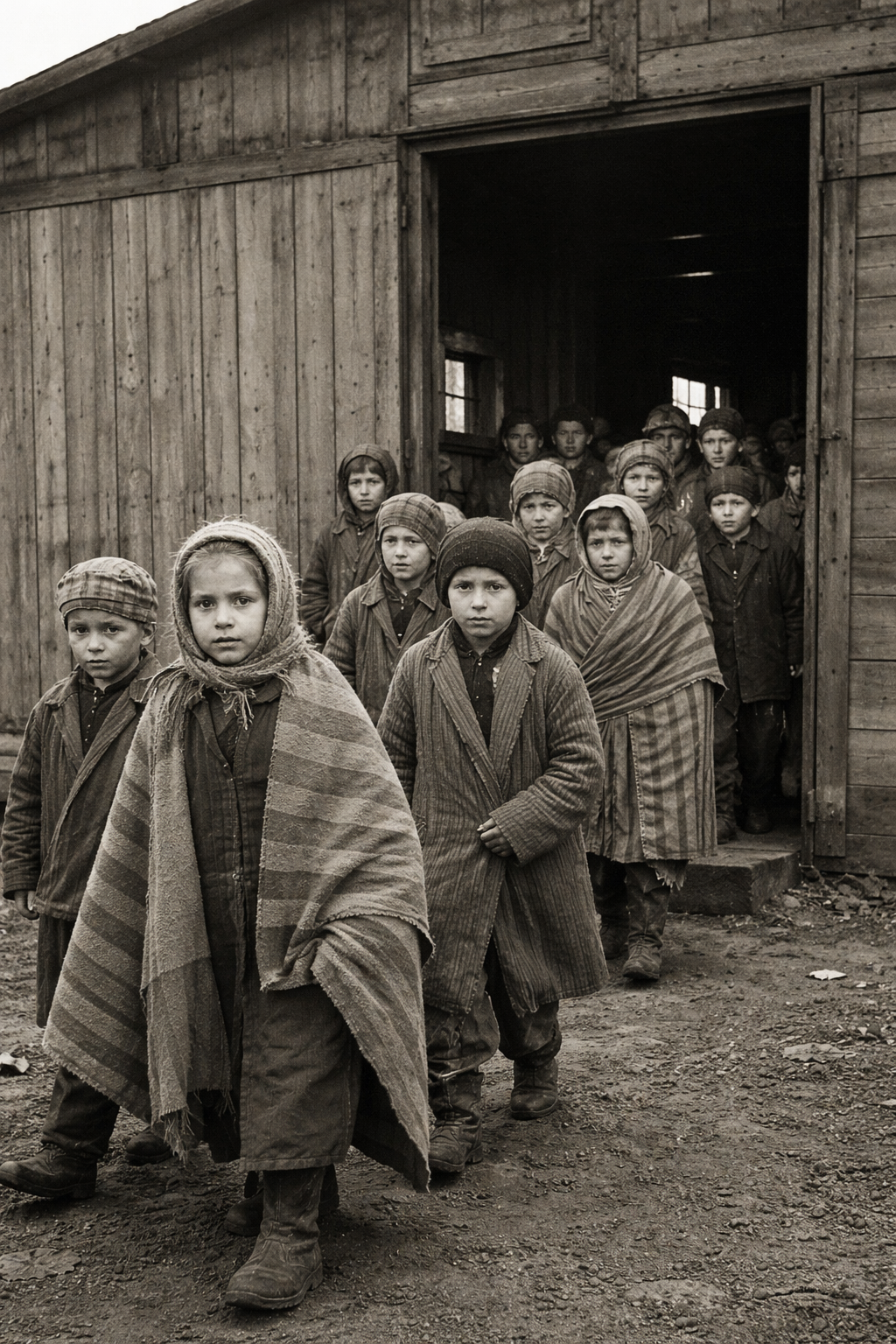
Children walking out of Auschwitz Concentration Camp
***
What the Pattern Actually Shows
Strip away ideology and conspiracy. What remains is a recurring sociological dynamic, observable in many minority groups under stress:
– ‘Durable identity’: Cultural and religious mechanisms that preserve cohesion across generations.
– ‘Minority visibility’: Distinct practices, networks, or occupational concentrations make the group an easy focal point.
– ‘Crisis scapegoating’: During economic collapse, plague, war, or political upheaval, blame is externalised onto the most salient “other.”
– ‘Myth-making’: Simple conspiracy narratives (blood libel, world domination) replace complex causal analysis.
These are not claims about inherent Jewish traits. They are descriptions of how stressed majorities treat coherent, visible minorities—whether Jewish, Armenian, Rohingya, or Uyghur. Jewish history simply offers the longest continuous dataset.
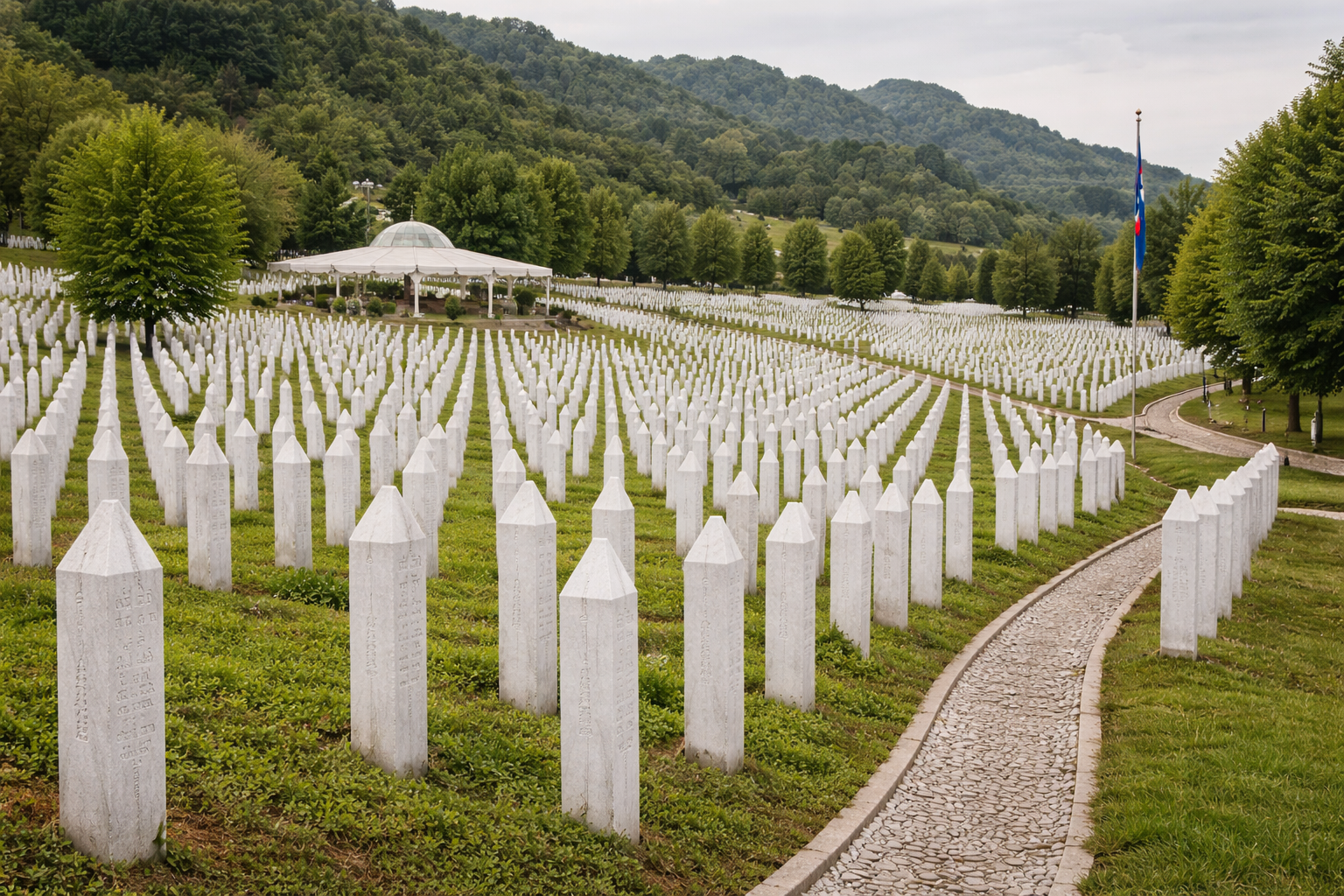
A stark modern European example is the persecution of Bosnian Muslims during the 1992–1995 Bosnian War. As Yugoslavia disintegrated amid economic collapse, political fragmentation, and rising ethnic nationalism, Bosniak (Bosnian Muslim) communities—often identified by their religious and cultural distinctiveness in a multi-ethnic society—became targets of systematic ethnic cleansing. Bosnian Serb forces, seeking to create contiguous Serb-dominated territory, subjected Bosniaks to mass expulsions, concentration camps, widespread rape as a weapon of war, and the genocidal massacre at Srebrenica in July 1995, where over 8,000 Muslim men and boys were murdered in the single largest atrocity in Europe since World War II. Here, visible religious difference combined with territorial ambitions and societal breakdown turned a minority into the scapegoat for broader fears of loss and identity erosion. The same underlying logic—cohesion and visibility making a group an easy focal point during crisis—operated with brutal efficiency
***
The Modern Question: Israel, Gaza, and Lebanon
Here the historical lens must be applied with surgical precision—and then deliberately set aside. The State of Israel, founded in 1948, is a sovereign political entity created in the aftermath of the Holocaust and amid the collapse of the British Mandate. Its population includes Jews from every diaspora community, but also Druze, Arabs, Circassians, and others. Its government is accountable under international law like any other state. Jewish identity and Israeli citizenship are not identical.
Contemporary conflicts—in Gaza, the West Bank, and along the Lebanese border—are rooted in:
– Competing national claims to the same land.
– Security imperatives after repeated wars and terrorist campaigns.
– Deep historical grievances on all sides: the Palestinian Nakba, Jewish refugee expulsions from Arab countries, cycles of suicide bombings, rocket fire, and military responses.
None of these can be reduced to “2,500 years of antisemitism.” Palestinian suffering—civilian deaths, displacement, blockade—is real and demands moral attention. Israeli civilian suffering—October 7, 2023, massacres, endless rocket barrages, hostage-taking—is equally real. Both are human tragedies, not abstractions.
The historical pattern explains why some criticism of Israel slides into classical antisemitic tropes (star of David = octopus, global Jewish control). It does not license Israeli actions that violate proportionality or international norms. History illuminates motive; it never authorises the targeting of civilians.
Where “Impartiality” Must End
An impartial historical analysis can trace causes and expose recurring dynamics. It cannot—and must not—slide into moral equivalence where facts forbid it.
– The persecution of Jews across two millennia is empirically documented in thousands of primary sources.
– The suffering of Palestinians, Lebanese civilians, and others in the current conflicts is also empirically documented and morally indefensible.
Understanding the first does not negate the second. The moral rule is simple and universal: the deliberate killing of non-combatants is wrong, full stop—whether in a medieval pogrom, a Nazi death camp, or a modern war zone.
Final Reflection
The deeper lesson is not that Jews are uniquely targeted or uniquely virtuous. It is that human societies under stress reliably seek a visible “other” to blame. Jewish communities have filled that role for over two millennia because their cohesion made them visible and their success made them resented. But the same logic has been applied to countless groups.
1. Overseas Chinese in Southeast Asia (especially Indonesia, Vietnam, Philippines)
Ethnic Chinese minorities have long functioned as classic “middleman minorities”—dominant in retail, trade, moneylending, and small business. They maintained strong family and clan networks, preserved cultural distinctiveness (language, cuisine, festivals), and often achieved higher economic success than the indigenous majorities.
- In Indonesia, anti-Chinese riots and pogroms erupted repeatedly, notably in 1965–66 (hundreds of thousands killed amid political turmoil) and 1998 (widespread violence, rapes, and looting during the Asian financial crisis). Chinese shops were burned, and the community was accused of economic exploitation and disloyalty.
- In Vietnam after 1975, the communist government confiscated Chinese-owned businesses and expelled large numbers of ethnic Chinese (Hoa people), framing them as capitalist parasites.
- Similar resentment has appeared in the Philippines and Malaysia during economic downturns. The mechanism mirrors the Jewish case: success in visible economic niches breeds envy, which crises amplify into violence or expulsion.
2. Indians (South Asians) in East Africa, especially Uganda under Idi Amin (1972)
British colonial rule brought many Indians to Uganda as labourers (e.g., building the Uganda Railway) and later as traders, clerks, and entrepreneurs. By independence, they controlled a large share of retail trade, small manufacturing, and professional services—often 90% of certain business sectors—while maintaining distinct cultural and religious practices (Hindu, Muslim, Sikh communities with tight family networks).
In 1972, dictator Idi Amin expelled nearly 80,000 Asians (mostly Indians and Pakistanis), giving them 90 days to leave. He accused them of “sabotaging” the economy, hoarding wealth, and failing to integrate. Properties were seized and redistributed. The expulsion devastated Uganda’s economy but was popular among segments of the population resentful of Asian success during post-independence economic struggles and political instability. Many resettled in Britain, Canada, or India. This is a near-textbook case of a successful, visible minority scapegoated during a regime’s push for “Africanisation.”
3. Armenians in the Late Ottoman Empire (leading to the 1915 Genocide)
Armenians were a Christian minority in a Muslim-majority empire. They developed strong communal cohesion through churches, schools, and merchant networks. Many excelled in trade, finance, crafts, and professions—often more prosperous than average Ottoman subjects in urban areas.
As the empire declined (military defeats in the Balkans and against Russia, economic woes, rising Turkish nationalism), Armenians were portrayed as disloyal “internal enemies” collaborating with foreign powers. Propaganda accused them of economic exploitation and treason. This culminated in the Armenian Genocide (1915–1923), with mass deportations, massacres, and deaths estimated at 1–1.5 million. The pattern: a cohesive, successful, visibly different minority blamed for the empire’s broader failures during wartime stress.
4. Lebanese (and other “Levantine”) traders in West Africa
Lebanese immigrants (often Christian or Shia Muslim) arrived in countries like Sierra Leone, Ivory Coast, and Senegal in the late 19th/early 20th centuries. They dominated retail trade, import-export, and small-scale commerce, building tight-knit family businesses and maintaining cultural/religious distinctions.
During economic or political crises, they faced resentment, boycotts, violence, or expulsion threats. In Sierra Leone, for example, they were accused of exploitation. The same middleman dynamic appears indispensable to the economy yet visible and “foreign,” making them targets when locals faced hardship.
5. Other notable cases
- Igbos in Nigeria (Biafran War era, 1960s): The Igbo ethnic group was disproportionately successful in trade, education, and civil service in pre-war Nigeria. During political crisis and secession, they were scapegoated as domineering, leading to pogroms and the Nigerian Civil War.
- Japanese Americans during WWII: A small, cohesive, high-achieving minority (strong family structures, success in agriculture and business) was interned en masse after Pearl Harbor amid wartime fear and economic competition on the West Coast.
- Greeks and Armenians in the Ottoman Empire: Both were Christian commercial minorities; similar resentment and violence during imperial decline.
- Broader pattern in “middleman minorities” theory (sociologist Edna Bonacich and others): Groups like these often face hostility precisely because they fill economic roles majorities avoid or cannot access, then become symbols of exploitation when stress hits.
These examples show the logic is not ethnic or religious in origin but structural. Cohesion + visibility + niche success + societal stress = scapegoating. Jewish communities fit this pattern over millennia because of their unusually long-documented history of maintaining portable identity (text, law, liturgy) amid dispersion. But the same forces have targeted many others—often with tragic results.
The real test for our time is whether we have internalised that lesson enough to resist it—no matter who the victims are, and no matter how satisfying the scapegoat narrative feels.
***
Call to Action
If history teaches anything, it is that moral clarity matters most when it is hardest to maintain. Question every narrative that reduces complex suffering to a single villain. Examine primary evidence, not memes or slogans. And refuse—absolutely refuse—to justify the deliberate killing of innocents, anywhere, by anyone. That refusal is the only firewall between civilisation and the next chapter of the same old pattern.
For a sharp, contemporary exploration of this same dynamic—how societies under pressure continue to project their fears and failures onto visible minorities today—I encourage readers to explore The Ashen Standard. (https://amzn.eu/d/01T3CBM3) It offers a clear-eyed modern lens on these recurring patterns without romanticising any side or excusing violence. It is a modern take on George Orwell’s 1984.
If history teaches anything, it is that moral clarity matters most when it is hardest to maintain. Question every narrative that reduces complex suffering to a single villain. Examine primary evidence, not memes or slogans. And refuse—absolutely refuse—to justify the deliberate killing of innocents, anywhere, by anyone. That refusal is the only firewall between civilisation and the next chapter of the same old pattern.
Shankar Kashyap

 shankar kashyap
Leave a comment