


Limerick
Limerick is a five-line witty poem with a distinctive rhythm, funny and often rude. Named after the Irish town of Limerick, the poem allegedly got its name from the town custom of shouting “Will you come up to Limerick?” after a performance of nonsense poetry at social gatherings. However the actual origin of the name is not certain.
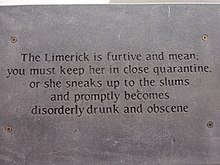
It was introduced in 1791 in Ireland. The noble and often a staid stature of an epic or ballad could not be more at odds with the ‘nonsense verse’ of the Limerick. The limerick is a brief and bouncy poem ideal for Mother Goose-style nursery rhymes. Most of the limerick’s were simple and filled with fun. Not many were constructed with any serious message of note. The speech stress is often distorted in the first line as a feature.
The first, second and fifth lines (the longer lines) rhyme and the third and fourth shorter lines rhyme. (A-A-B-B-A). First line is often repeated as the fifth line. Verses of Limericks were constructed using the last line as a refrain and made them interesting to listen to. Several variations have emerged over the years. One variation removed the rhyming structure completely!
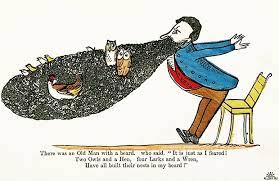
Limericks was popularised in 19th century by Edward Lear. It went through a period where they were considered obscene and looked down by the literati as folklore and not literature. Edward Lear published a series of ‘Nonsense’ limerick compositions during the middle of 19th century.
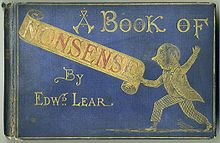
This is one of the few, often quoted from his “Book of Nonsense.” Here the first line clearly shows the distorted feature of the speech stress.
There was a Young Person of Smyrna
Whose grandmother threatened to burn her.
But she seized on the cat,
and said ‘Granny, burn that!
You incongruous old woman of Smyrna!
As you can see, this does not offer any message or wit. In fact, apart from the rhyming structure which makes it more than adequate for singing it doesn’t really mean anything. Here is my take on a Limerick on a glass of wine;
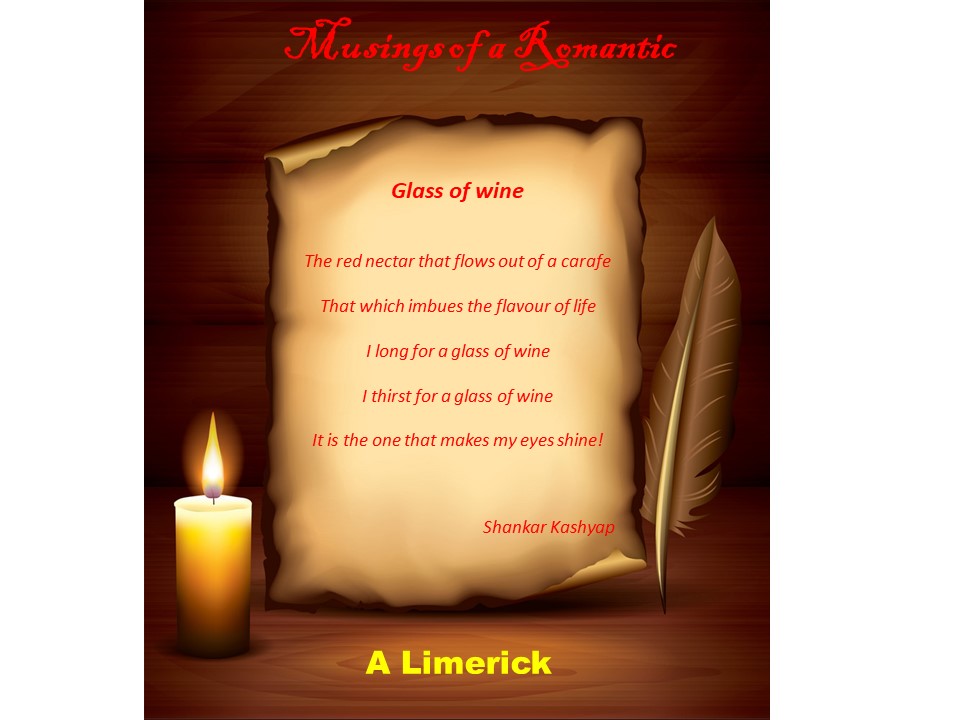
Glass of wine
The red nectar that flows out of a carafe
That which imbues the flavour of life
I long for a glass of wine
I thirst for a glass of wine
It is the one that makes my eyes shine!
Shankar Kashyap

 shankar kashyap
Leave a comment