


This week’s poem is a Haiku.
This ancient form of poetry writing from 17th century Japan is renowned for its small size as well as the precise punctuation and syllables needed on its three lines. Originally, Haiku’s were the opening stanza of a style of a longer format poem called the Renga, or linked verse, but the compactness of these introductory lines intrigued Japanese poets of the 17th century. Soon, the Haiku broke away from its longer version into the three-line poems with seventeen syllables popular in Japan today.
The Japanese Haiku is a rigidly structured poetic form with very little scope for ‘poetic license’. Haiku’s are composed of 3 phrases, each a phrase, often with three different qualities. There is juxta-positioning of phrases or qualities between lines. The first line typically has 5 syllables, second line has 7 and the 3rd line repeats another 5. Quite often, there is a seasonal reference. It is written in the present tense, often read out in a single breath with sometimes a pause at the end of first or second line. Its focus is on a brief moment in time and used colourful images for impact. There are many forms and varieties of Haiku in practice. In Japanese, it is written in single vertical line and in English it comes out as three lines.
There is a “cutting word” or Kireje at the end of the second line giving the structure for the three phrases.
Haiku did not make its appearance in English till the beginning of 20th century. It is not as popular as the other forms of poetry in English mainly due to its rigid structure of construction and poets felt restricted in use of flowery language.
“The Other world”;
Whitecaps on the bay:
A broken signboard banging
In the April wind.
Richard Wright
As you can see there are no rhyming structure and doesn’t allow for the poet to elaborate on what he wants to say. Whereas couplets with just two lines were used as part of a much bigger poem, Haiku became a poem on its own once it broke away from being the introduction of Renga. It would be in a similar vein as a Matla for a Ghazal – an introduction to longer story or epic about a hero or king or country.
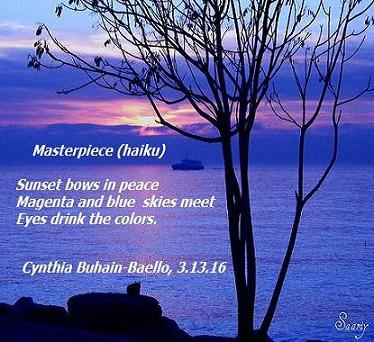
Another example of a Haiku is by well known poet, Cynthia Buhain-Baello;
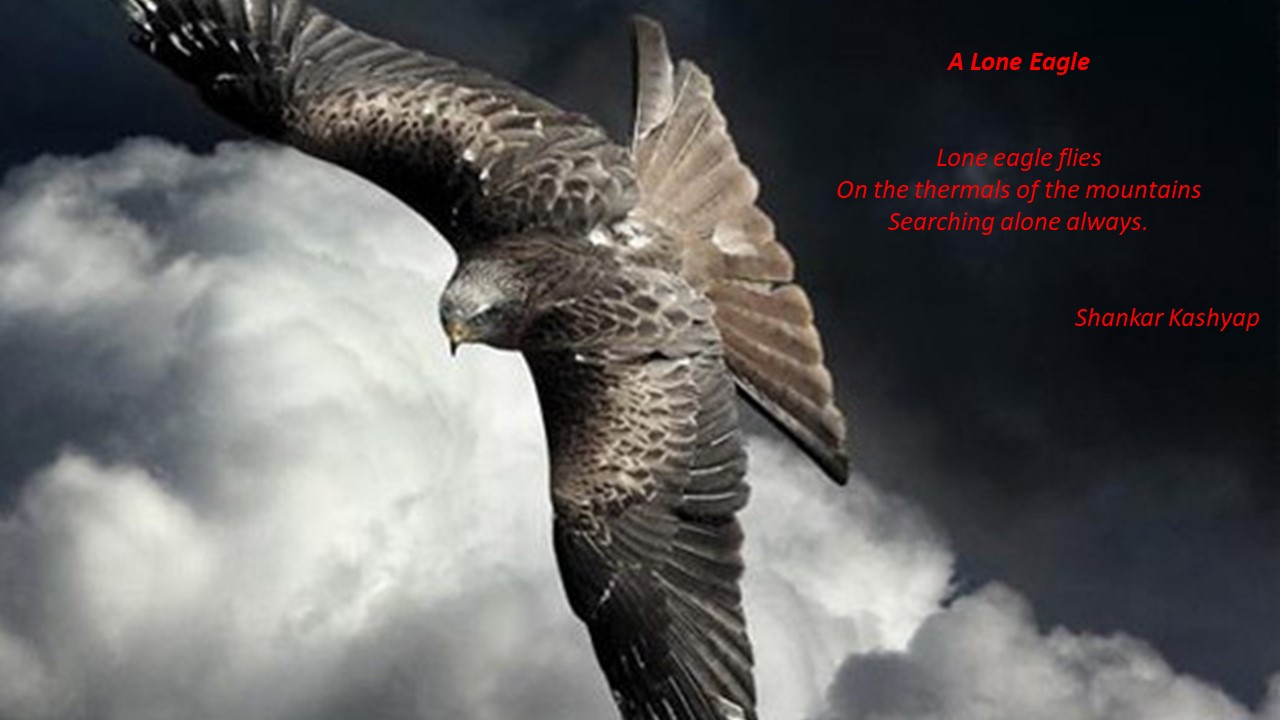
My attempt at a Haiku, A lone Eagle, was originally an introduction to a much longer poem on a Himalayan bird of prey – the majestic eagle.
Enjoy this short and very interesting format of poetry. It has taken off in English in recent times and there has been many variations introduced by the western poets.
Shankar Kashyap
 shankar kashyap
Leave a comment